Urolithin A moisture content results are meaningful only when the method, sample condition and reporting basis are clear.
Urolithin A moisture content can influence powder flow, agglomeration, density, blending, packaging and storage. It can also affect how a laboratory prepares the sample and interprets an assay result. For that reason, buyers should distinguish loss on drying from water-specific measurement, and moisture content from water activity. The correct test depends on the decision the material must support. In procurement reviews, Urolithin A moisture content should therefore be read with the method and sample basis, not as an isolated percentage.
This guide is for ingredient buyers, QA reviewers, analytical laboratories, process engineers and contract manufacturers. It explains moisture methods, sampling, conditioning, package effects, water activity, specifications, trend review, investigations and method transfer. It does not set one universal moisture limit for every Urolithin A grade or application.
Working rule: report moisture with the sample basis, method, conditioning and package history; a percentage without that context is not a complete physical-quality result.
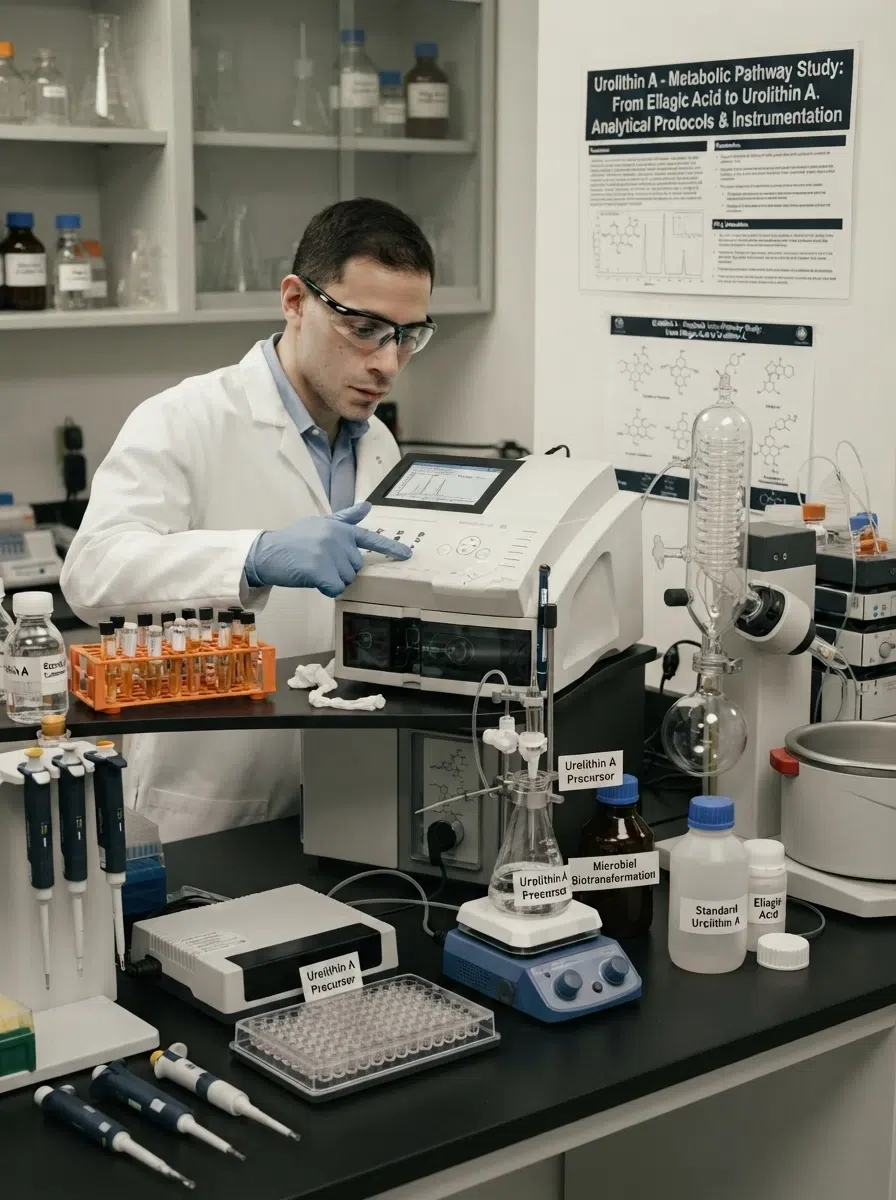
What Urolithin A moisture content can tell a buyer
Moisture testing estimates the amount of water or volatile material associated with a sample under a defined method. The result can support raw-material release, process control, packaging review, flow troubleshooting or stability assessment.
The number does not automatically show where the water is located, whether it is strongly bound, whether it can participate in a reaction or how the powder will behave at another humidity. Those questions may require water activity, thermal analysis, Karl Fischer measurement, microscopy or a controlled process trial.
Moisture decision map
| Decision | Useful moisture evidence | Additional evidence |
|---|---|---|
| Incoming release | Lot-specific moisture result against the current limit | Representative sampling and package inspection |
| Powder handling | Moisture, water activity, density and flow data | Equipment trial under defined humidity |
| Packaging choice | Moisture uptake under container and storage conditions | Package barrier and closure evidence |
| Stability review | Time-point moisture and related physical or chemical results | Long-term package and chamber records |
| Method comparison | Same sample measured by aligned procedures | Bias, recovery and repeatability assessment |
Use the Urolithina Lab quality framework to organize the request, then define the moisture decision in the buyer’s specification or process protocol.
Urolithin A moisture content and water activity
Moisture content is the amount of water or volatile loss measured by a defined procedure. Water activity describes the availability of water for physical, chemical or microbiological processes under the test condition. Two powders can have similar moisture content but different water activity if their water is held differently.
Moisture content is often reported as a percentage by mass. Water activity is reported as a dimensionless value between zero and one. The two results answer different questions and should not be substituted for each other.
Moisture terminology
| Term | What it describes | Use carefully |
|---|---|---|
| Moisture content | Measured mass fraction of water or volatile loss | Method and basis must be stated |
| Water activity | Water availability at defined temperature | Not a direct replacement for moisture percentage |
| Loss on drying | Mass lost under specified heat, time and pressure | May include volatile material other than water |
| Karl Fischer water | Water measured by a chemical reaction | Reagent, extraction and endpoint affect the result |
| Equilibrium moisture | Moisture reached after exposure to a defined humidity | Condition and equilibration time are essential |
A supplier should identify which term appears in the TDS, specification and COA. Replacing “water” with “moisture” without changing the method can create a misleading comparison. The same Urolithin A moisture content label can mean different things if the method basis changes.
Choose loss on drying for the right question
Loss on drying measures mass loss after heating under controlled conditions. It is practical for routine powder testing, but the result may include water, residual solvent or another volatile component. The temperature, time, pressure, sample mass, pan and endpoint should be controlled.
Use LOD when the method has been shown to represent the attribute the specification intends to control. If a volatile process solvent could contribute to the loss, a water-specific method may be needed.
LOD method fields
- Temperature, pressure and drying time.
- Sample mass, pan type and layer thickness.
- Balance resolution and calibration status.
- Endpoint rule: fixed time, constant mass or instrument criterion.
- Cooling and weighing condition after drying.
- Whether volatile solvents or other components could contribute.
Do not compare an oven LOD and a moisture-balance result as if they were the same method. Even small differences in heating and endpoint can produce different values.
Use Karl Fischer when water specificity matters
Karl Fischer titration measures water through a chemical reaction and can be useful when the distinction between water and other volatiles matters. The laboratory may use volumetric or coulometric equipment, direct titration or an extraction approach.
Review sample solubility, extraction efficiency, reagent suitability, endpoint detection, blank correction and drift. A powder that does not dissolve or release water completely can give a low result even when the instrument is functioning correctly.
Karl Fischer review questions
| Question | Evidence | Why it matters |
|---|---|---|
| Does the sample dissolve or release water? | Solvent, extraction or heating study | Incomplete release biases the result |
| Is the reagent suitable? | Reagent factor, blank and drift record | Reagent condition affects calculation |
| Is the endpoint controlled? | Instrument setting and suitability check | Endpoint drift changes reported water |
| Is the sample handled quickly? | Opening, weighing and injection timestamps | Powder can exchange moisture with air |
| Is the method specific? | Interference and recovery evidence | Matrix or solvent can affect the reaction |
For a method comparison, test the same lot by LOD and Karl Fischer under controlled conditions and document the reason for any systematic difference.
Measure water activity for availability and storage decisions
Water activity measurement equilibrates a sample in a sealed chamber and measures the vapour condition above it at a defined temperature. The result can help assess moisture-driven powder changes, microbial growth potential and package performance, but it is not a direct assay of total water.
Temperature control, sample cup filling, equilibration time, sensor condition and sample homogeneity affect the result. A water-activity instrument should be checked with appropriate standards and maintained under a documented procedure.
Water-activity fields
- Measurement temperature and equilibration criterion.
- Sample mass, cup fill and surface condition.
- Instrument calibration or verification standard.
- Sensor status, cleaning and response time.
- Sample opening and conditioning history.
- Interpretation of the result for the material and package.
Use water activity when the process question concerns available water. Use moisture content when the specification controls mass fraction. In some projects, both are useful because they describe different failure modes.
Design Urolithin A moisture content sampling
Moisture can vary by container, depth and location. The outside of a bag may exchange moisture with air while the centre remains unchanged. A powder can also segregate by density or form local agglomerates with different moisture.
Define the number of containers, sampling locations, portion size, composite rule, exposure time and sample-seal method. Use moisture-tight containers and minimize the interval between opening and analysis.
Sampling-plan fields
| Field | Record | Review purpose |
|---|---|---|
| Container | Lot, unit number and package condition | Links result to a physical portion |
| Location | Top, middle, bottom or defined point | Checks moisture gradients |
| Portion | Mass, tool and composite rule | Supports method and reserve needs |
| Exposure | Open time, humidity and transfer container | Explains moisture exchange |
| Timing | Sampling, receipt and test start | Shows whether the sample changed before analysis |
A supplier’s typical moisture result is useful for screening, but it is not a lot-specific release result unless the lot and sampling event are identified.
Control conditioning and laboratory humidity
Powders can gain or lose moisture while being sampled, weighed, sieved or prepared. The laboratory should define the conditioning environment, equilibration time, container opening rule and maximum exposure before the test begins.
When a method requires equilibration, record the actual relative humidity and temperature. A result generated after uncontrolled bench exposure may reflect the laboratory environment rather than the received powder.
Conditioning checklist
- Record the sample’s package and storage history.
- Define whether the portion is tested as received or conditioned.
- Control temperature and relative humidity during preparation.
- Minimize open time and reseal unused material.
- Record equilibration time and endpoint.
- Use a reserve portion if the first test is inconclusive.
Align conditioning between supplier and buyer laboratories before comparing moisture results from different reports.
Connect moisture to powder flow and particle behaviour
Moisture can change cohesion, electrostatic charge, agglomeration, bulk density and flow. A modest moisture shift may have little effect on assay while changing feeder performance or blend uniformity.
Review moisture with particle-size distribution, density and flow data when a process problem appears. Do not infer flow from moisture alone; equipment geometry and powder history still matter.
Moisture-to-process map
| Observation | Moisture question | Supporting check |
|---|---|---|
| Powder bridges or stalls | Did moisture or water activity shift? | Density, flow and wall-residue review |
| New agglomerates | Was the powder exposed to humid air? | PSD, microscopy and package inspection |
| Blend variation | Did moisture create a density or cohesion difference? | Blend samples and conditioning records |
| Changed fill weight | Did bulk density move after storage? | Bulk and tapped density trend |
| Slow dispersion | Are wetting and agglomerate conditions different? | Defined dispersion trial and water activity |
The Urolithin A product page provides the starting material context; confirm the actual physical behaviour using the lot, package and process in scope.
Link Urolithin A moisture content to packaging and storage
Moisture control depends on the container, liner, seal, headspace, fill quantity, storage environment and opening pattern. A high-barrier sealed pack may perform differently from a small bottle opened repeatedly during production.
Compare the package used in the moisture or stability study with the commercial pack. If the package changes, assess the barrier, closure and expected exposure before carrying forward the old moisture statement.
Package-review questions
- What container and liner were used in the study?
- Does the commercial pack have the same barrier and closure?
- How much headspace and fill surface are exposed?
- How often will the pack be opened and resealed?
- What warehouse temperature and humidity are assumed?
- How are transport excursions and damaged seals assessed?
Include package configuration in the quality documentation request so that moisture data remain linked to the container they describe.
Set Urolithin A moisture content and water-activity specifications
A specification limit should control a defined process or storage decision. Use development data, historical lots, method repeatability, package evidence and equipment trials to select a range. Do not choose a narrow limit that is smaller than normal method variation. For that reason, the Urolithin A moisture content limit should be tied to a defined method and use case.
State the test, unit, basis, sample condition, number of portions and action when the result is outside the range. If water activity is included, state the measurement temperature and equilibration rule.
Specification-design questions
- Does the limit control water, total volatile loss or a physical behaviour?
- Is the method capable of resolving the proposed range?
- Does the sample represent the lot and container?
- Are moisture and water activity both needed?
- What package and storage condition support the limit?
- What happens when a result is near or beyond the limit?
For document support, use the technical resources page to request method summaries, historical trends and package information.
Compare supplier and buyer moisture methods
Two laboratories can test the same lot and report different moisture values because of heating, endpoint, extraction, sample mass, conditioning, instrument or calculation differences. Align the method inputs before comparing the results.
Use a shared lot and independent preparations where possible. Record the sample split, package, storage, method, instrument, replicate plan and reporting basis.
Method-comparison table
| Variable | Laboratory A | Laboratory B | Question |
|---|---|---|---|
| Method | LOD, Karl Fischer or water activity | LOD, Karl Fischer or water activity | Are the methods measuring the same attribute? |
| Condition | Temperature, humidity and equilibration | Temperature, humidity and equilibration | Was moisture exchange controlled? |
| Sample | Lot, container and portion | Lot, container and portion | Were comparable portions tested? |
| Calculation | Basis, blank, endpoint and rounding | Basis, blank, endpoint and rounding | Are values calculated alike? |
| Precision | Replicates and method variation | Replicates and method variation | Is the difference larger than method variation? |
When methods are not equivalent, define which attribute controls the decision instead of forcing numerical agreement.
Review Urolithin A moisture content during stability studies
Moisture should be considered in a stability program when the package or storage environment can change water uptake, density, flow, agglomeration or related chemical attributes. Test the commercial package and record chamber exposure, time point and sample condition.
Review moisture alongside assay, related substances, appearance, particle properties and water activity where appropriate. A stable assay does not prove stable powder behaviour, so Urolithin A moisture content should be trended with the package and physical data.
Stability-moisture fields
| Field | Record | Interpretation |
|---|---|---|
| Package | Container, liner, closure and fill | Defines moisture barrier and exposure |
| Condition | Temperature, humidity, light and time | Defines the storage challenge |
| Moisture | Method, value, basis and replicate | Shows water or volatile change |
| Physical response | PSD, density, flow and appearance | Shows practical powder effects |
| Chemical response | Assay and related substances | Shows whether chemical attributes move |
Use the site’s quality framework to request the package and stability records that support a moisture statement.
Investigate an unexpected moisture result
When a moisture result is outside its expected range, verify sample identity, package condition, opening time, conditioning, method, instrument status, calibration, calculation and reference materials. Then review shipping, storage, drying, packaging and process history.
Preserve the original sample and data. A quick repeat after leaving the container open can create a new moisture condition rather than clarify the first result.
Investigation sequence
- Confirm lot, container, sample location and chain of custody.
- Review package seal, storage and transport exposure.
- Check conditioning, open time, sample mass and preparation.
- Review instrument calibration, blank, standard and endpoint.
- Compare related properties such as water activity, density and flow.
- Define any retest or resample under an approved plan.
- Record root cause, disposition and follow-up action.
Link the investigation to stability, change-control or supplier records when the evidence indicates a package or process shift.
Control Urolithin A moisture content during processing and transfer
Moisture exposure can occur during dispensing, screening, blending, sieving, transfer, sampling and filling. Define the maximum open time, room condition, container closure, transfer path and post-process hold.
When a dry-room or controlled-humidity area is used, record the condition and response to excursions. The control should match the powder’s sensitivity and the process decision.
Process-moisture controls
- Open containers only at the defined processing step.
- Use labelled, sealed intermediate containers.
- Record room temperature and relative humidity when relevant.
- Control exposure during weighing and sampling.
- Set a maximum hold time before the next process step.
- Inspect agglomeration, density or flow after an excursion.
Connect process controls to the batch record so the moisture history can be reviewed with the final result.
Set supplier and buyer responsibilities
The supplier controls manufacturing, drying, packaging and release testing. The buyer controls receiving, storage, opening and use in its own facility. The quality agreement should state which moisture result is supplied, which testing is independent and how differences are investigated.
Define notification for a new drying condition, package, warehouse, test method or moisture limit. Identify the first affected lot and required comparison evidence.
Responsibility matrix
| Activity | Supplier | Buyer |
|---|---|---|
| Method | Validate or verify the agreed procedure | Confirm method suitability for receiving use |
| Package | Qualify and control the commercial pack | Store and open under defined conditions |
| Lot result | Provide lot-specific evidence | Review and release under the buyer SOP |
| Excursion | Assess manufacturing or shipping exposure | Assess warehouse and process exposure |
| Change | Notify before affected supply | Review, approve or condition receipt |
Clear boundaries stop a supplier’s storage statement from being applied to a package opened repeatedly in a different warehouse.
Use quality references within their scope
The ICH quality-guideline library provides a useful reference for stability and quality-system thinking. For U.S. dietary-supplement records, 21 CFR 111.70 describes component and finished-product specification concepts within that defined framework.
These references do not supply a universal moisture limit for every Urolithin A material. Apply the requirement that matches the product category, market, package and intended process.
Build a moisture evidence package
A complete moisture file should show the sample, method, package, condition, result, review and decision. Include method validation or verification, sample map, raw data, calibration, trend, stability or excursion records as appropriate.
Evidence-package index
| File | Minimum content | Decision supported |
|---|---|---|
| Specification | Moisture or water-activity limit, method and basis | Release interpretation |
| Sampling record | Lot, containers, locations and exposure time | Representativeness |
| Method record | Procedure, calibration, controls and precision | Result validity |
| Package record | Container, liner, seal and storage condition | Moisture-protection scope |
| Trend or stability | Time points, values and related attributes | Storage or retest decision |
| Investigation | Original result, review, action and disposition | Exception closure |
Use the technical resources page to organize the file request, while keeping the approved record in the buyer’s quality system.
Build a buyer-side moisture scorecard
A scorecard helps teams distinguish a controlled moisture program from a supplier brochure with one percentage. Evaluate the method, sample and package together.
Moisture evidence scorecard
| Area | Strong evidence | Conditional evidence | Gap |
|---|---|---|---|
| Attribute | Moisture content and water activity are clearly distinguished | One attribute is defined; second is under review | “Moisture” with no method |
| Method | LOD or Karl Fischer procedure is controlled and suitable | Method summary available on request | Instrument name only |
| Sampling | Container, location, exposure and reserve are recorded | Lot known but exposure detail limited | Unidentified scoop sample |
| Package | Commercial container and storage scope are linked | Package information pending | Generic storage phrase |
| Trend | Moisture is reviewed with physical and chemical attributes | Single-lot data with follow-up planned | One isolated percentage |
| Disposition | Limit, investigation and status rules are defined | Clarification open with owner | No action rule |
Use the scorecard to identify the next useful measurement or document. It does not replace a validated method, stability program, package qualification or incoming release SOP.
Frequently asked questions about Urolithin A moisture content
Is loss on drying the same as water content?
Not always. Loss on drying can include water and other volatile material. Use a water-specific method when the distinction matters and document the method basis.
When should water activity be tested?
Use it when water availability, powder behaviour, storage or microbiological conditions are part of the decision. It complements moisture content but does not replace it automatically.
Why do supplier and buyer moisture results differ?
Sampling, open time, humidity, method temperature, endpoint, sample mass and instrument differences can all contribute. Compare aligned procedures and the same lot before concluding that the material changed.
Can a moisture limit be copied from another powder?
No. The limit should reflect the material, process, package, method capability and handling decision. A value suitable for another powder may be too broad or too narrow here.
What should happen when moisture is above the limit?
Place the lot into the defined quality status, preserve the original sample and data, check method and sampling conditions, review package and storage history, and follow the approved investigation and disposition process.
Does low moisture guarantee good flow?
No. Particle size, density, shape, electrostatics, consolidation and equipment geometry also influence flow. Confirm the physical behaviour with a defined test or process trial.
Should moisture be tested on every lot?
The frequency depends on process capability, package, history, intended use and the buyer’s specification. A reduced frequency should have a written rationale and change or trend triggers.
Turn moisture data into a controlled material decision
A defensible Urolithin A moisture content program connects the powder, sample, method, package, environment and decision. The result is useful when another qualified reviewer can tell whether it measures water, volatile loss or water availability, and whether the value applies to the lot and package in scope.
Before approving a moisture specification or storage statement, request the method, sampling plan, package details, historical trend, related physical data and investigation rule. For a lot-specific review, use the quality-file request form and include the destination market, product stage and records your quality system requires.
Scope note: This article is a B2B ingredient-quality framework. It does not replace the buyer’s validated methods, formal stability protocol, quality agreement, regulatory assessment or finished-product release system.