QUALITY / BATCH EVIDENCE
Urolithin A
Quality Control
& Batch Evidence.
Quality information organised for the questions buyers ask before a purchase order.
For high-quality,
consistent Urolithin A.
- IdentifyLink the sample label to the proposed lot and specification.
- MeasureReview the stated methods, limits and lot results.
- DecideCheck application and market needs before approval.
In functional nutrition, sports nutrition and healthy-aging ingredient development, our focus goes beyond the research buzz around Urolithin A — what matters is whether the ingredient has a well-defined structure, a measurable assay and consistent batch-to-batch performance.
Urolithin A (UA) is not a fixed constituent that occurs abundantly in pomegranates, walnuts or berries. It is a postbiotic metabolite formed when polyphenols such as ellagitannins and ellagic acid are converted by specific gut microorganisms. Because gut microbiota composition varies between individuals, food precursors alone cannot guarantee a reproducible Urolithin A outcome.
That is why we believe the key to industrializing Urolithin A lies not just in finding plant sources rich in ellagitannins, but in building an ingredient manufacturing system with defined sourcing, controlled processes, stable content and traceable impurities. For brands, formulators and contract manufacturers, a dependable UA ingredient needs a clear product specification, batch test results and quality documentation suited to the target market — supporting downstream formulation development, sample testing and regulatory review.
From incoming raw materials to finished-goods release, we focus on the following control points:
- 01Identity, purity and batch variability of the starting materials or precursor substrates
- 02Key process parameters along the production route and their allowed variation ranges
- 03The ratio of Urolithin A to other urolithin isomers and related by-products
- 04Control of ellagic acid residues, process by-products, residual solvents and elemental impurities during purification
- 05The impact of drying, milling, packaging and storage on assay, particle size, color and dispersibility
- 06Assay consistency and stability performance across production batches
We never judge an ingredient by a single "purity percentage." Beyond the assay value, we evaluate the material holistically, combining the analytical method, the related-substances profile, representative COAs, stability data and batch traceability. This helps customers judge more accurately whether the material is ready to enter formal formulation development and supplier qualification processes.
Our controlled process
and QC system.
The production of Urolithin A involves multiple stages: precursor or starting-material management, target-product formation, separation and purification, drying and stabilization, and finished-goods release. We bring laboratory research, process validation, quality testing and production management into a single quality-control system, continuously improving the reproducibility and supply stability of the ingredient.
At the laboratory stage, a buyer should confirm the identity and quality of the starting material or precursor substrate, then review the documented conversion system, reaction conditions, endpoint criteria and controls for the proposed lot. If the route is microbial fermentation, relevant evidence includes culture conditions, biotransformation controls, target formation and related substances. Enzymatic, synthetic and semi-synthetic routes require different process and impurity controls. The actual manufacturing route, site and test methods should be confirmed in the current quality file before the material is qualified.
During process scale-up, we translate the validated key parameters into control requirements for commercial production, and record and track raw materials, in-process samples, intermediates and final products. By testing samples at different stages, we identify changes in assay, related substances and physicochemical properties in time, reducing the impact of production variation on final-product consistency.
In post-processing, we apply tiered control of Urolithin A assay, related substances, residual solvents, elemental impurities and microbiological indicators across separation, purification, concentration and drying. Depending on the customer's dosage form and application, we can also evaluate powder particle size, bulk density, solubility and dispersibility and hygroscopicity, as well as the compatibility of the ingredient with proteins, amino acids, oils and fats, and beverage bases.
In our quality laboratory, HPLC, LC-MS or other confirmed analytical methods are used to test the identity, assay and related-substances profile of Urolithin A. For each project, confirm the applicable release specification and which COA, SDS, TDS, stability data, process-route description or independent test reports are currently available before relying on them.
Our quality control does not stop at final-product testing — it runs through the entire chain of raw materials, process, analysis, packaging and storage. For long-term supply projects, we also combine stability observation, packaging compatibility and batch records to help customers assess how the ingredient performs during transport and storage.
Through systematic management from laboratory research to factory production, we turn Urolithin A from a single research compound into a standardized ingredient ready for formal formulation review, quality audit and procurement processes. For product development in sports nutrition, mitochondrial nutrition and healthy aging, customers can confirm sample-testing plans, analytical panels and batch-supply terms with us based on target assay, dosage form, packaging, intended dosage and target-market requirements.
Connect the submitted sample with its label and applicable documents.
Compare assay and related substances with the agreed specification.
Record formulation checks and destination-market requirements separately.
Colour tells you what
to test next.
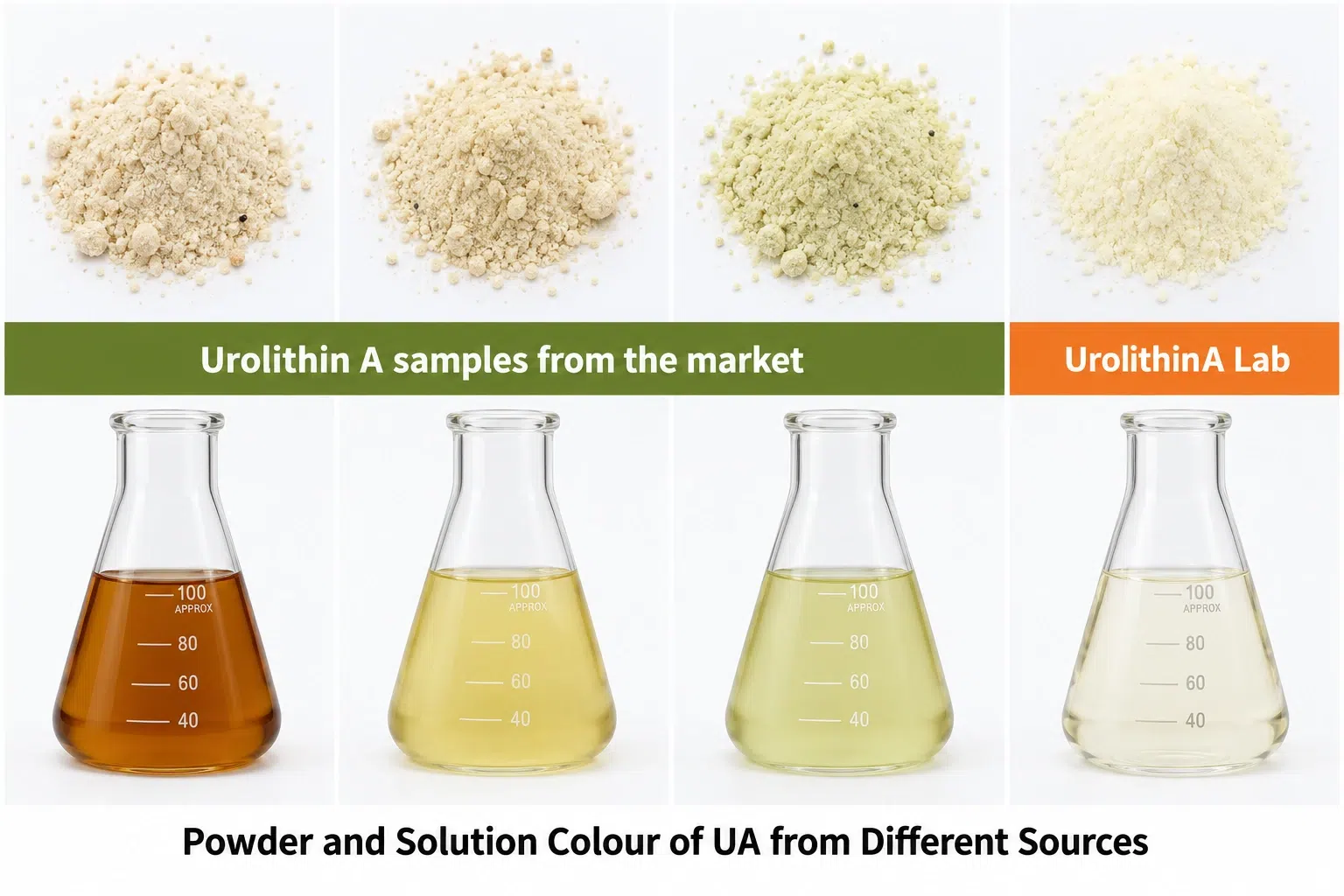
A dull powder is a question, not a verdict. How we use appearance — and where it stops.
Three questions for any supplier
- Which appearance attributes sit on the specification, and which are only reported as observed?
- Was appearance judged visually, by colorimetry, or as part of a defined particle-size distribution?
- What happens when an incoming lot falls outside the sample you approved?
A batch can look immaculate and still fail assay. A slightly dull one can pass every specification set against it. So we start with appearance — and we never finish there.
The impurities that travel with Urolithin A are rarely colourless. Residual ellagic acid, related urolithin isomers, oxidation products and solvent residues all leave a mark on the powder, and on the solution it forms. Drying and milling conditions shift particle size, bulk density and dispersibility, which change how the powder scatters light and how readily it dissolves. None of these are numbers, but all of them are visible.
Set side by side, the same nominal material can look markedly different: a coarse, slightly clumped powder with a muted tone beside a finer, more uniform one; a deep amber solution beside a pale, almost colourless one. Part of that gap is quality. Part of it is not — particle size, moisture content and even the glassware will move what you see.
Which is exactly why we do not grade material by eye, and do not ask you to. Read appearance as a screening signal: it tells you which questions to ask and which lots to sample. The answers have to come from the assay and the related-substances profile, run against a stated method and a stated reference standard.
Our answer to the third is fixed: it becomes a deviation to investigate, record and explain — not a shade to negotiate. Where your dosage form depends on colour, particle size or dispersibility, those attributes belong on the agreed specification, and the batch record should show what was measured and against which method.
From appearance to the next test
Appearance can help set an investigation order, but it cannot identify a compound or establish batch purity. Compare samples under the same lighting and preparation conditions, then use the agreed specification and validated method to decide whether a lot passes.
| Observation | What to check next | What appearance cannot prove |
|---|---|---|
| Colour differs from the approved sample | Confirm sample preparation; compare HPLC assay and related-substances profiles; investigate moisture or oxidation where relevant. | The identity or amount of a specific impurity. |
| Powder clumps or flows differently | Review moisture, particle-size distribution, bulk density, packaging and storage history. | Assay or microbiological status. |
| Solution appears darker or less clear | Control solvent, concentration and pH; then assess solubility, visible particles and chromatographic profile. | That the ingredient is suitable or unsuitable for a finished formulation. |
| Unexpected odour or visible foreign matter | Quarantine the sample and request an investigation against the relevant identity, contaminant and handling controls. | The root cause without analytical and batch records. |
For a document-by-document review, use the Urolithin A COA guide. If your team needs an independent result, follow the third-party testing workflow and agree the sample chain of custody before testing.
How independent testing fits a buyer review
Independent testing is most useful when the buyer and supplier first agree on the identity of the sampled lot, the test panel, the analytical method and the reporting basis. A laboratory result should identify the sample received and the methods used; it should not be treated as a substitute for the manufacturer’s release record or the buyer’s finished-product assessment.
For a new supplier, request the current lot COA and specification, then define any confirmatory assay, related-substances, residual-solvent, elemental-impurity or microbiological tests that the project requires. Our independent testing guide explains how to brief an accredited laboratory and compare its report with the release documents. Any laboratory, method, cost and timetable must be agreed for the specific project; this page does not name an exclusive testing partner.
Include the destination market and intended dosage form in your procurement brief so the document and test requests match the intended use.
Quality and COA questions
What should I read first on a Urolithin A COA?
Match the product identity, lot number, specification version, test method, result, limit and release date. Confirm that the COA belongs to the sample or commercial lot under review.
Does a high HPLC assay prove the material is suitable?
No. Review the calculation basis and reference standard alongside related substances, contaminants, physical attributes and your finished-product requirements.
What is the difference between HPLC and LC-MS?
HPLC separates and quantifies components using a defined detector and method. LC-MS adds mass information that can help investigate identity or unknown peaks. Neither label alone establishes a validated method or an acceptable result.
How should impurity limits be assessed?
Compare each reported result with the agreed current specification and the destination-market requirements. Ask how unknown or unreported peaks are handled and whether the method is suitable for the limit being applied.
How can I check batch traceability?
Link the sample label, COA lot number, manufacturing or packing record and shipment documents. Resolve any mismatch before treating a test report as evidence for that lot.
Can powder colour replace analytical testing?
No. Colour is a screening observation. Assay, identity, related substances and any application-specific attributes need the agreed methods and acceptance criteria.
When should a buyer request independent testing?
Use it when your qualification plan or a discrepancy calls for confirmatory results. Define the lot, sampling method, chain of custody, panel and reporting limits before commissioning a laboratory.
Does a raw-material COA certify the final product?
No. It reports the ingredient lot against stated criteria. The buyer remains responsible for formulation compatibility, finished-product tests and market-specific review.
These answers describe a buyer review process. Confirm current lot documents and agreed limits for each enquiry.
Need the quality file?
Tell us your market, format and project stage. We will route the relevant specification, COA example or test-panel discussion for our Urolithin A powder.
Request quality documents ↗