A defensible Urolithin A solubility testing result starts with one distinction: rapid dispersion is not the same as equilibrium, and a clear sample is not automatically a reliable solubility result.
Urolithin A solubility testing needs a clear distinction between equilibrium solubility, kinetic dispersion, dissolution rate and suspension stability. The result depends on pH, temperature, medium composition, particle history, mixing, filtration, sampling time and analytical recovery. Without those conditions, two laboratories can report different values while testing the same material.
This guide is for formulation scientists, analytical laboratories, process engineers, ingredient buyers and contract manufacturers. It explains how to design a meaningful solubility or dispersion study, choose a medium, control pH and temperature, sample and filter, quantify the target, assess excipients and transfer the method to a larger process. It does not prescribe a finished formula or a consumer-use instruction.
Working rule: report solubility with the medium, temperature, pH, equilibration time, sample preparation and analytical method; a single concentration without those fields is not a transferable result.
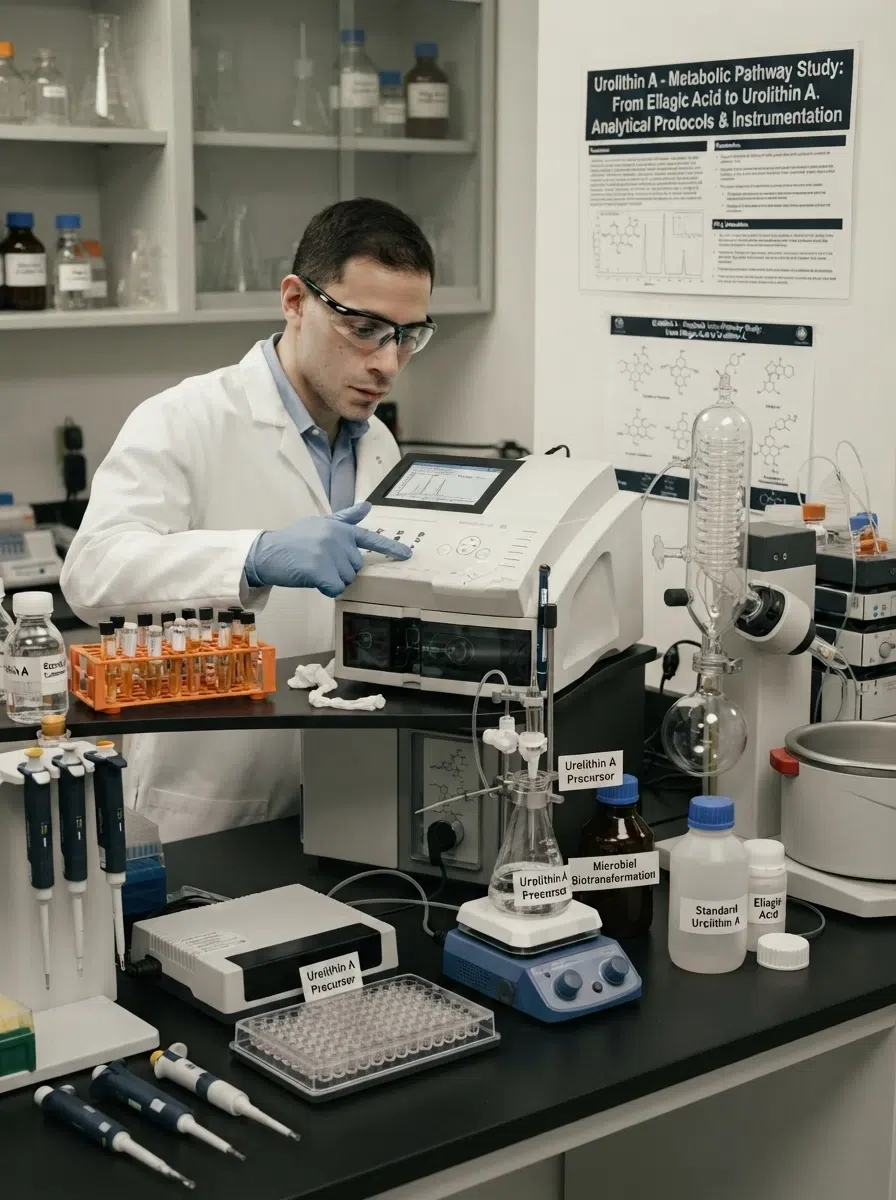
What Urolithin A solubility testing should establish
Solubility testing asks how much material dissolves in a defined medium at a defined temperature after reaching an agreed equilibrium or endpoint. Dispersion testing asks how the powder distributes through the medium over time, even when some material remains suspended or undissolved.
These are different measurements. A kinetic dispersion can look uniform for several minutes while the dissolved concentration later changes. An equilibrium study may show a stable dissolved concentration but say little about how quickly a production mixer can wet and disperse the powder.
Decision map
| Decision | Useful evidence | Additional evidence |
|---|---|---|
| Screen a medium | Defined concentration, pH, temperature and visual dispersion | Equilibrium confirmation and analytical recovery |
| Compare suppliers | Same lot basis, method, medium and endpoint | Particle and package history |
| Choose a process | Wetting time, mixing energy, residue and filtration behaviour | Equipment-scale trial |
| Measure dissolved concentration | Separated sample and validated quantitative method | Mass balance and stability of the test solution |
| Support a formulation study | Matrix-specific solubility or dispersion profile | Compatibility and storage study |
Use the Urolithin A product context to confirm the starting material, then define the study around the intended matrix and process.
Separate equilibrium solubility, kinetic dispersion and dissolution
Equilibrium solubility is measured after the dissolved concentration no longer changes materially under the defined condition. Kinetic dispersion records how quickly the powder wets, breaks apart and distributes through a medium. Dissolution rate describes the change in dissolved concentration over time.
A Urolithin A solubility testing report should use the term that matches the experiment. “Solubility” should not describe a five-minute visual mixing test, and “dispersible” should not be interpreted as a saturation concentration.
Terminology table
| Term | What it measures | What it does not prove |
|---|---|---|
| Equilibrium solubility | Dissolved concentration at a defined equilibrium condition | Fast processing or complete dissolution in another medium |
| Kinetic dispersion | Distribution and visual or analytical change over time | Equilibrium concentration |
| Dissolution rate | Change in dissolved concentration over time | Final saturation value without an endpoint |
| Suspension stability | Settling, redispersion and concentration profile over time | True molecular solubility |
| Apparent solubility | Measured concentration under a stated separation and assay method | Independence from filtration or colloidal material |
Use the terminology in the protocol, report and development decision consistently. Ambiguous language creates unnecessary disagreement between laboratories.
Define the medium for Urolithin A solubility testing
Medium composition controls pH, ionic strength, polarity, buffer capacity, surfactant content and the presence of co-solvents. A result in purified water cannot be assumed to describe a buffered system, a beverage base or a powder reconstitution medium.
List each component, concentration, grade, preparation date and storage condition. If a co-solvent or surfactant is used, state its concentration and explain whether the result is intended for screening or a realistic product matrix.
Medium-design fields
- Water source and conductivity or quality specification.
- Buffer identity, concentration and pH.
- Salt, surfactant, co-solvent or carrier concentration.
- Medium volume, sample concentration and vessel size.
- Preparation, filtration, degassing and storage condition.
- Blank and placebo controls for the analytical method.
Keep the medium simple during the first screen. Add complexity only when it answers a defined formulation or process question.
Map pH and temperature deliberately
pH and temperature can change ionisation, molecular interactions, wetting, precipitation and degradation. Use a planned matrix rather than testing one convenient condition and generalising the result.
Measure pH at the test temperature when possible. Record the initial pH and the final pH after the material has contacted the medium. A powder or excipient can shift pH during the experiment.
Condition matrix
| Factor | Levels to define | Record |
|---|---|---|
| pH | Target values and buffer capacity | Initial and final pH, temperature and instrument |
| Temperature | Development, processing or storage-relevant values | Set point, actual value and equilibration |
| Time | Early dispersion, kinetic points and equilibrium endpoint | Sampling clock and mixing status |
| Agitation | Speed, geometry and energy input | Impeller, stir bar or shaker settings |
| Concentration | Screening and intended-use levels | Mass, volume and preparation basis |
Use enough pH and temperature points to show the trend. A single value can be useful for a defined process, but it should not be described as a general solubility profile.
Control sample preparation and particle history
Sample particle size, agglomeration, moisture, milling history and storage can affect wetting and apparent dissolution. Record whether the powder is tested as received, screened, milled, pre-wetted or deagglomerated.
Weigh the sample quickly in a controlled environment and transfer it without loss. If the test begins after a delay, record the delay and container. A moisture-sensitive powder may behave differently after exposure to laboratory air.
Sample-preparation checklist
- Identify product, grade, lot, package and sample condition.
- Record particle-size or agglomerate treatment before the test.
- Define sample mass, medium volume and target concentration.
- Control the time from weighing to medium contact.
- Use blank, placebo and reference preparations where needed.
- Record visible residue, clumps, colour or phase separation.
The quality documentation framework can help organize sample identity and method records for a supplier comparison.
Choose agitation and endpoint rules
Agitation controls wetting, particle breakup, suspension and mass transfer. Stirring speed alone does not describe energy input because vessel size, impeller, liquid depth and geometry also matter.
Define whether the endpoint is a fixed time, a stable dissolved concentration, a constant visual observation, a mass balance or a combination. For equilibrium studies, show that additional mixing or time does not materially change the result.
Agitation fields
| Field | What to report | Why it matters |
|---|---|---|
| Vessel | Material, diameter, volume and headspace | Defines fluid movement and surface exposure |
| Agitator | Stir bar, impeller, shaker or rotor type | Different devices create different shear |
| Speed | RPM, amplitude or flow setting | Allows a comparable setup |
| Time | Contact, sampling and equilibration schedule | Separates kinetic and equilibrium observations |
| Endpoint | Concentration, appearance or stability criterion | Defines when the test is complete |
Do not compare a vortexing screen with a low-shear equilibrium study without stating that the experiments answer different questions.
Separate dissolved material from suspended or colloidal material
A sample taken from a cloudy mixture can contain dissolved molecules, fine particles and colloidal material. The reported concentration depends on how the sample is separated before analysis.
Define settling time, centrifugation, filtration, filter material, pore size and rinse procedure. Verify that the separation step does not adsorb the target or allow fine particles to pass inconsistently.
Separation-method comparison
| Step | Strength | Control point |
|---|---|---|
| Settling | Simple separation with minimal hardware | Time, temperature and particle settling behaviour |
| Centrifugation | Rapid separation of fine suspended material | RCF, time, temperature and tube material |
| Filtration | Convenient removal of particles before HPLC | Adsorption, pore size and filter compatibility |
| Ultrafiltration | Can assess selected colloidal or molecular fractions | Membrane retention, recovery and pressure |
Use a recovery study to show how much target is lost during separation. Report whether the result is dissolved concentration, filtered concentration or total recoverable material.
Quantify Urolithin A with a suitable analytical method
HPLC or another validated quantitative method can measure Urolithin A in the separated sample. The calibration range, standard, sample dilution, detector, specificity and solution stability should match the expected concentration.
Check whether the medium, buffer, surfactant or excipient interferes with the response. A clear sample can still contain matrix effects. Use blank, placebo, standard-spike and recovery preparations.
Quantitation checklist
- Reference standard identity, lot and assigned value.
- Calibration range covering every sample concentration.
- Blank and placebo chromatograms or equivalent controls.
- Recovery after filtration, centrifugation or dilution.
- Precision at the expected dissolved concentration.
- Solution hold time and temperature control.
- Mass balance or residue measurement where relevant.
For analytical-method detail, the technical resources page can support requests for method summaries and matrix-recovery evidence.
Use mass balance to check recovery
Mass balance compares the amount added with dissolved, suspended, vessel-retained and recovered fractions. It can reveal adsorption, incomplete transfer, degradation, precipitation or an analytical response problem.
For Urolithin A solubility testing, the calculation should state the sample amount, medium volume, concentration basis, residue measurement and uncertainty. A low dissolved concentration is easier to interpret when the remaining material is accounted for.
Mass-balance fields
| Fraction | Measurement | Question |
|---|---|---|
| Added | Weighed target and carrier or excipient | Was the starting amount accurate and representative? |
| Dissolved | Separated liquid concentration and volume | Is the analytical method specific and recovered? |
| Suspended | Filter, centrifuge or residue fraction | Was undissolved material measured? |
| Vessel or filter | Rinse or extraction recovery | Did contact surfaces retain material? |
| Unaccounted | Difference after correction and uncertainty | Does the method or process need investigation? |
Mass balance is especially useful when visual clarity and measured concentration do not agree.
Evaluate excipient and matrix effects
Carriers, buffers, surfactants, salts, flavours, oils and other formulation components can change wetting, ionisation, aggregation and precipitation. Test one variable at a time during early screening, then confirm the selected matrix under process conditions.
Record the order of addition, pre-hydration, mixing energy, temperature and sample age. An excipient that improves initial dispersion may also change the concentration measured after storage.
Matrix-screen fields
- Component identity, grade and concentration.
- pH and buffer capacity after all components are added.
- Order of addition and pre-mixing time.
- Visual dispersion, residue and settling profile.
- Dissolved concentration at defined time points.
- Precipitation or concentration change during hold.
Keep screening results separate from a final product specification. A small matrix trial supports development; it does not establish universal performance across formulas.
Assess pH-shift, precipitation and re-dispersion
A sample can appear dissolved at one time point and then precipitate as pH, temperature or concentration changes. Measure the pH after preparation, inspect at multiple times and record whether gentle agitation restores the suspension.
Distinguish reversible settling from new precipitation or irreversible agglomeration. The distinction matters to process design and to the interpretation of dissolved concentration.
Observation record
| Observation | Record | Interpretation question |
|---|---|---|
| Initial wetting | Time to wet, float, clump or sink | Is powder surface behaviour limiting? |
| Dispersion | Visual uniformity and mixing condition | Is the test kinetic or near equilibrium? |
| Settling | Layer height and time | Is material suspended or dissolved? |
| Precipitation | Onset time, pH and temperature | Did a condition change trigger a new phase? |
| Redispersion | Agitation required and final appearance | Is the change reversible under the process? |
Photographs can support the record, but they should be linked to time, vessel, lighting and sample condition.
Control temperature and sample timing in Urolithin A solubility testing
Temperature affects solubility, viscosity, pH, evaporation and precipitation. Record actual temperature at preparation, mixing, sampling and analysis. If the sample cools during filtration or transfer, document the change.
Use a sampling clock that begins at a defined event, such as first contact between powder and medium. Delayed sampling can turn a kinetic test into an unplanned equilibrium test.
Timing fields
- Record powder addition and medium-contact time.
- Record agitation start, speed changes and pauses.
- Withdraw samples at labelled time points.
- Record filtration or centrifugation start and finish.
- Start analytical preparation within the allowed hold time.
- Record temperature at every critical step.
Synchronised timing is essential when comparing supplier or laboratory results.
Design a Urolithin A solubility testing transfer study
Transfer should compare sample, medium, equipment, separation and calculation—not only final concentration. Use a shared lot or matched material and run independent preparations at both laboratories.
If one laboratory uses filtration and another uses centrifugation, define whether the methods measure the same fraction. A numerical comparison may be inappropriate when the separation question differs.
Transfer-plan fields
| Field | Align | Record |
|---|---|---|
| Material | Lot, particle history, package and storage | Sample split and chain of custody |
| Medium | Composition, pH, volume and preparation | Preparation record and blank |
| Agitation | Vessel, speed, time and temperature | Actual settings and deviations |
| Separation | Settling, filter, centrifuge and recovery | Filter or tube lot and recovery study |
| Analysis | Calibration, method, dilution and calculation | Raw data and reviewed results |
Predefine acceptance criteria and how method-specific bias will be handled. Do not label two methods equivalent solely because their averages are close.
Scale a solubility or dispersion test to process equipment
A bench vortexer, magnetic stirrer or small beaker may not reproduce a production tank, inline mixer or reconstitution vessel. Scale-up should compare liquid depth, impeller geometry, tip speed, shear, powder addition rate, temperature and sampling position.
Run a first process-scale trial with enhanced sampling and a defined time course. Check wall residue, unmixed zones, foam, temperature rise, filtration load and concentration at multiple positions.
Scale-up comparison
- Vessel volume, liquid depth and headspace.
- Impeller type, position, speed and power input.
- Powder addition location, rate and wetting sequence.
- Temperature control and pH adjustment.
- Sampling points, timing and separation method.
- Transfer, hold and final package conditions.
Keep the small-scale method as a screening tool unless comparability to the process-scale method has been demonstrated.
Review solution and suspension stability
A dissolved concentration can change during a hold because of precipitation, adsorption, degradation, evaporation or microbial activity in a matrix. Define the solution or suspension container, light, temperature, headspace, mixing and test time.
Measure the attribute that matters at each time point. A visual check alone cannot show a small concentration change, while an assay alone may miss visible settling or phase separation.
Hold-time fields
| Field | Record | Decision use |
|---|---|---|
| Container | Material, closure and headspace | Defines contact and evaporation exposure |
| Condition | Temperature, light and movement | Represents process or storage |
| Time points | Initial, intermediate and final samples | Shows change rate |
| Appearance | Clarity, colour, sediment and phase | Shows physical change |
| Concentration | Separated sample and analytical result | Shows dissolved or total fraction |
Use a hold-time conclusion only for the tested matrix, package and condition. Do not transfer it to a different finished product without a technical bridge.
Investigate an unexpected solubility result
When a result differs from expectation, confirm material identity, particle history, medium preparation, pH, temperature, agitation, timing, separation, filtration recovery and analytical calculation. Review whether the sample contained suspended material or whether precipitation occurred before analysis.
Preserve the original preparation and photographs where possible. A new test with a different medium or separation method may answer a different question rather than explain the first result.
Investigation sequence
- Verify lot, grade, package and sample condition.
- Check medium composition, pH, temperature and preparation date.
- Review agitation, timing, separation and filter recovery.
- Check calibration, blank, standard, matrix interference and solution hold.
- Compare visual, residue, mass-balance and concentration data.
- Define any repeat or new study under an approved protocol.
- Record root cause, process impact and follow-up action.
Link the investigation to particle, moisture, supplier or change-control records when those factors may explain the result.
Build a Urolithin A solubility testing evidence package
A complete study file should allow another reviewer to reconstruct the material, medium, condition, timing, separation and calculation. Include the protocol, sample map, medium recipe, raw observations, analytical data, recovery, mass balance and conclusion.
Evidence-package index
| File | Minimum content | Purpose |
|---|---|---|
| Protocol | Question, medium, pH, temperature, time and endpoint | Defines study scope |
| Sample record | Lot, particle history, mass and package | Connects result to material |
| Preparation | Medium, addition, agitation and timing | Supports reproducibility |
| Separation | Filter, centrifuge, settling and recovery | Defines measured fraction |
| Analysis | Calibration, chromatograms, calculations and review | Supports concentration result |
| Conclusion | Limitations, matrix scope and next decision | Controls how data are used |
Use the technical resources page to organize a supplier or laboratory data request, while keeping the approved study report under document control.
Build a buyer-side solubility scorecard
A scorecard helps a buyer distinguish a controlled solubility study from a visual mixing demonstration. Evaluate the question, method and matrix together.
Solubility evidence scorecard
| Area | Strong evidence | Conditional evidence | Gap |
|---|---|---|---|
| Question | Equilibrium, kinetic or process purpose is explicit | Purpose clear but endpoint pending | “Solubility” with no definition |
| Medium | Composition, pH, temperature and preparation controlled | Water screen with limited matrix detail | Medium not specified |
| Sampling | Time, temperature, separation and recovery recorded | Visual time points with limited recovery | Uncontrolled aliquot |
| Analysis | Specific method, calibration, blank and recovery | Method summary available on request | Clarity used as concentration |
| Scale | Process-equipment comparison and enhanced first trial | Bench data with scale-up plan | Bench result presented as production proof |
| Limits | Matrix, package and time scope are stated | Screening conclusion with open study | Universal claim |
Use the scorecard to request the next useful experiment or document. It does not replace formulation development, analytical validation, stability work or finished-product release testing.
Use scientific references within their scope
For dissolution-related method thinking, the FDA dissolution-testing guidance provides a useful reference for controlled media, apparatus and sampling concepts. Adapt the approach to an ingredient solubility or dispersion study rather than copying a finished-dosage-form procedure.
For chemical identity and analytical naming, use a recognized compound record such as the PubChem Urolithin A entry. Public identity information does not replace lot-specific sample and method controls.
Frequently asked questions about Urolithin A solubility testing
Is a clear solution proof of complete dissolution?
No. Fine suspended or colloidal material can be difficult to see. Separate the sample and quantify the dissolved fraction with a suitable method.
Can a five-minute dispersion result be called solubility?
Only if the protocol defines that kinetic endpoint and uses the term appropriately. It is usually better described as a dispersion or early dissolution observation.
Why does pH change the result?
pH can affect ionisation, molecular interactions, precipitation and the response of the matrix. Record initial and final pH under controlled temperature.
Should filtration always be used before HPLC?
Not automatically. Filtration can remove particles but may also adsorb the target or allow fine material to pass. Validate the separation and recovery for the specific matrix.
Can a surfactant improve solubility?
It may change wetting, aggregation or apparent dissolved concentration. Record its identity and concentration, and distinguish a screening result from a final product decision.
How should a buyer compare supplier solubility data?
Align lot, particle history, medium, pH, temperature, agitation, time, separation and analytical method. Values from different conditions are not direct supplier rankings.
Does solubility remain constant during storage?
Not necessarily. Moisture, particle history, temperature, pH, precipitation and package exposure can change the result. Use a defined hold or stability study for the matrix and package.
Turn solubility data into a useful development decision
A defensible Urolithin A solubility testing program distinguishes equilibrium from dispersion, controls the medium and temperature, records sampling and separation, verifies analytical recovery and states the limits of the conclusion. The result becomes valuable when another team can reproduce the condition and understand which fraction was measured.
Before approving a formulation or process claim, request the protocol, medium recipe, pH and temperature records, sample history, separation recovery, quantitative method, time-course data and matrix limitations. For a project-specific review, use the quality-file request form and include the target matrix, process stage and required evidence.
Scope note: This article is a B2B ingredient and formulation-development framework. It does not replace the buyer’s validated methods, formal stability protocol, quality agreement, regulatory assessment or finished-product release system.