An out-of-specification result is a quality event that needs an evidence trail, not an informal request for a more convenient number.
Urolithin A OOS investigation should establish what happened, whether the result is valid, which lot and records may be affected, and who can authorise the final disposition. The investigation must preserve the original data while checking laboratory execution, sample identity, method performance, manufacturing history and supplier information in a controlled sequence.
This guide is for QA reviewers, analytical laboratories, ingredient buyers, contract manufacturers and supplier-quality teams. It explains a two-stage investigation model, retest and resampling boundaries, batch-impact review, supplier communication, root-cause analysis, CAPA and closure evidence. The final procedure should follow the buyer’s approved quality system, quality agreement and destination-market requirements.
Working rule: investigate the original result first; a later passing result does not erase the first result or its data trail.
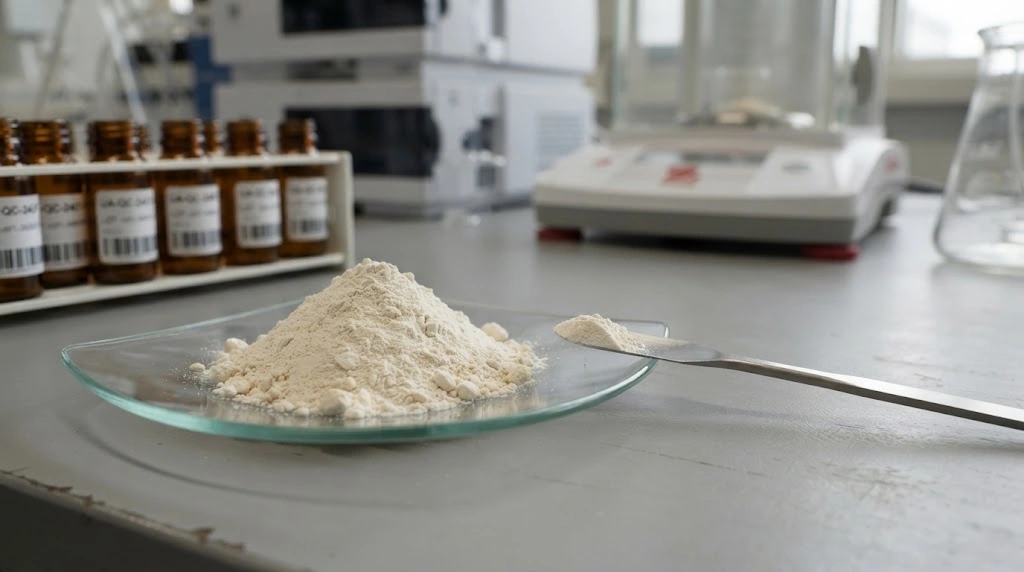
What an OOS investigation should establish
An OOS result is a result outside an approved specification or acceptance criterion. The investigation should determine whether the result reflects the material, the sampling process, the analytical procedure, a calculation or another assignable cause. It should also assess whether other lots, methods or customers are affected.
The investigation is not complete when a laboratory repeats the test and obtains a passing result. The team must explain the relationship between the original and later data and document the authorised lot decision.
OOS decision map
| Stage | Question | Controlled outcome |
|---|---|---|
| Detection | What result, limit, method and sample were involved? | OOS record and quality status |
| Laboratory assessment | Is there a documented execution or data error? | Assignable laboratory cause or full investigation |
| Manufacturing assessment | Could the material or process explain the result? | Batch-impact and supplier review |
| Additional testing | Is retesting or resampling scientifically justified? | Approved protocol and interpretation rule |
| Disposition | What status is authorised for the lot and related stock? | Release, reject, rework, return or continued hold |
The Urolithina Lab quality framework can help organize the evidence request, while the buyer’s OOS SOP controls the official investigation.
Place the lot and related material under control
When an OOS result is reported, identify the affected lot, containers, samples, work-in-process, finished products and shipments. Apply the quality status required by the buyer’s procedure and stop an uncontrolled disposition while the review is open.
The status should be visible in physical labels and inventory systems. If material has already moved to another site or customer, record the transfer and escalation path immediately.
Immediate containment fields
- Product, grade, lot, batch and container identifiers.
- Test, method, specification version, result, unit and limit.
- Sample location, sampling date and chain-of-custody reference.
- Current inventory, work-in-process and shipment status.
- Quality status, owner, due date and escalation contact.
- Related lots tested by the same method or process.
Containment does not decide the final outcome. It protects the evidence and keeps the material status aligned with the open investigation.
Preserve original samples and laboratory data
Secure the original sample, preparation solution where stability permits, standards, reagents, vials, chromatograms, instrument files, calculations, worksheets and analyst notes. Record the condition and location of each item before any additional testing.
Do not discard a failed preparation or overwrite a data file because a repeat is planned. If a sample is consumed, damaged or unavailable, document that fact and assess its effect on the investigation.
Evidence-preservation checklist
| Evidence | Preservation action | Why it matters |
|---|---|---|
| Original sample | Seal, label and record storage condition | Supports later review or authorised resampling |
| Prepared solution | Record preparation time, hold condition and disposal | Assesses solution stability and repeat validity |
| Raw data | Lock original files and audit trails | Preserves integration and calculation history |
| Standards and reagents | Retain lot, expiry and preparation records | Checks response and preparation variables |
| Instrument status | Save sequence, maintenance and suitability data | Checks system performance at the time of testing |
Data preservation should occur before troubleshooting changes the test environment. The original record is the starting point for every later conclusion.
Run the laboratory Phase I assessment
The first phase asks whether the test was executed according to the approved procedure and whether a clear laboratory error invalidates the result. The assessment should be documented by a qualified reviewer who did not simply repeat the test.
Review the sample identity, preparation, calculations, instrument, method, system suitability, analyst training and data processing. If a clear assignable cause is proven, document why the original result is invalid under the procedure and define any required corrective action.
Phase I review questions
- Was the correct sample, lot and container tested?
- Were the current method and specification used?
- Were weights, dilutions, units and calculations transcribed correctly?
- Did blanks, standards, spikes and system-suitability checks meet criteria?
- Was the instrument calibrated, maintained and within status?
- Were sample and standard solutions within the allowed hold time?
- Did the analyst follow the procedure and record any deviation?
- Is there objective evidence of an assignable laboratory error?
A suspicion is not the same as a demonstrated error. “The result looks unusual” is a reason to investigate further, not a reason to discard it.
Check sample identity and preparation
Sample errors can arise before the instrument run. Confirm the lot, container, sampling location, label, mass, solvent, extraction, mixing, filtration, dilution and hold time. For a powder, check whether the portion was representative and whether moisture or agglomeration could influence preparation.
Compare the original preparation with the approved method and the analyst’s worksheet. A correct calculation applied to a wrong sample remains an invalid release basis.
Sample-preparation review
| Review point | Evidence | Possible finding |
|---|---|---|
| Identity | Sample label, lot, container and request | Wrong lot or mixed sample |
| Weighing | Balance ID, status, mass and record | Transcription or balance issue |
| Extraction | Solvent, time, mixing and temperature | Incomplete or inconsistent recovery |
| Filtration | Filter type, rinse and sample appearance | Adsorption, blockage or contamination |
| Hold time | Preparation and injection timestamps | Solution change before analysis |
If no preparation error is demonstrated, retain the original result and continue to the full investigation.
Review method, instrument and system suitability
Inspect the method version, column or instrument configuration, detector settings, calibration, blank, standard response, replicate precision, resolution, carryover and integration. Compare the actual sequence with the method’s required sequence.
For physical or microbiological tests, review the corresponding equipment, environment, sample condition and method controls. An OOS process should cover all attributes, not only chromatographic assays.
Instrument and method checks
- Method and specification revisions were current.
- Instrument qualification, calibration and maintenance were in status.
- System-suitability criteria were defined and met or investigated.
- Blank, standard, spike and control results were acceptable.
- Integration, calculation and rounding followed the procedure.
- Any instrument alarm, interruption or reprocessing is documented.
When a system-suitability failure occurs, determine which results are affected before deciding whether an OOS result can be invalidated.
Decide whether a clear laboratory cause exists
A laboratory cause should be supported by objective evidence such as a documented wrong dilution, failed system suitability, instrument malfunction or confirmed sample mix-up. The investigation should state how the cause explains the original result and whether other samples or lots are affected.
If a cause is not proven, do not label the OOS as laboratory error simply because a later result passes. Continue to the manufacturing and process assessment.
Assignable-cause table
| Potential cause | Evidence that may support it | Required decision |
|---|---|---|
| Calculation or transcription | Original worksheet, formula and verified correction | Assess affected reports and reissue control |
| Instrument failure | Alarm, maintenance, suitability or calibration record | Assess sequence validity and affected samples |
| Preparation error | Deviation, analyst interview and independent reconstruction | Determine whether original result is invalid |
| Sample mix-up | Label, chain-of-custody or container evidence | Review all related samples and lots |
| No assignable cause | Phase I review complete without proof of error | Continue full investigation; retain original result |
Document the decision in the OOS record, with the reviewer and approval date. A verbal conclusion is not sufficient for a release file.
Open the manufacturing and supplier Phase II investigation
Phase II examines whether the material or process could explain the result. Review batch records, raw-material lots, process parameters, yields, equipment status, cleaning, hold times, packaging, storage, deviations, previous lots and supplier communications.
For an incoming Urolithin A lot, include the supplier’s COA, specification, sampling record, change history and any independent testing. Ask the supplier to preserve its original data and investigate through its own quality system.
Phase II review fields
- Manufacturing and packing lot records.
- Starting-material and solvent lots.
- Process parameters, yield and material balance.
- Equipment, cleaning, calibration and maintenance status.
- Storage, transport, package and temperature history.
- Previous and subsequent lot trends.
- Supplier changes, deviations, complaints and CAPA.
Phase II should explain whether the result is isolated, lot-specific, process-related, method-related or still unresolved.
Set a retest plan before generating more data
Retesting should answer a defined question and follow a written protocol. State the number of preparations or injections, analyst, method, sample source, acceptance rule and interpretation before testing begins.
A retest is not a search for a passing result. If the original result remains valid and the retest differs, the investigation must explain the variation and decide how both sets of data affect the lot.
Retest-plan fields
| Field | Define before retest | Why it matters |
|---|---|---|
| Purpose | Question the retest is intended to answer | Avoids unstructured repeat testing |
| Sample | Original preparation, reserve or new portion | Shows what source the result represents |
| Method | Version, analyst, instrument and controls | Ensures a comparable result |
| Number | Preparations, injections and sequence | Prevents changing the plan after results appear |
| Interpretation | How original and retest results will be evaluated | Keeps disposition evidence-based |
Record the retest protocol and approval in the OOS file. If the method or sample changes, explain why and assess comparability.
Distinguish retesting from resampling
Retesting uses the original sample or preparation under an approved plan. Resampling takes a new portion from the lot. The two actions answer different questions and carry different assumptions about representativeness.
Resampling may be appropriate when the original sample was not representative or a documented sampling issue exists. It should not be used merely because the first result is inconvenient.
Retest and resample comparison
| Action | Question answered | Control needed |
|---|---|---|
| Repeat injection | Was instrument response or injection precision involved? | Sequence and system-suitability review |
| New preparation | Was sample preparation variation involved? | Independent preparation and protocol |
| Resample same container | Was the first portion unrepresentative? | Sampling rationale and location record |
| Resample other containers | Is the result container-specific or lot-wide? | Expanded sampling plan and disposition rule |
Never combine retest and resample results in one average without a documented statistical and quality rationale.
Evaluate batch impact and related lots
Determine whether the OOS result affects only the tested lot or also other lots, products, customers, methods or time periods. Review common raw materials, equipment, process changes, analytical runs and storage conditions.
For a supplier result, ask whether other customers received the same lot and whether a corrected COA or notification is required. For a manufacturing result, check work-in-process and finished batches that used the material.
Impact-assessment fields
- Tested lot and all containers represented.
- Related lots made before and after the event.
- Shared raw materials, equipment, method, analyst or laboratory.
- Shipments, production batches and customer destinations.
- Existing complaints, trends, deviations or changes.
- Additional testing, notification and disposition needs.
Document the scope even when no additional impact is found. “No impact” is a conclusion that needs a review basis.
Communicate with the supplier and laboratory
Supplier communication should state the lot, result, method, limit, sample, status and requested response. Ask for original records and an investigation summary, not only a replacement certificate.
Keep communications in the controlled OOS file. If the supplier proposes retesting, confirm that the buyer’s procedure and quality agreement allow the plan and define who approves it.
Supplier OOS request
- Identify product, lot, container and test field.
- Attach the result, method, limit and sample reference.
- State the current quality status and containment action.
- Request the supplier’s original data, investigation and batch impact.
- Define the response deadline and required approval.
- Record any corrected COA or customer notification under revision control.
For a structured file request, use the quality-file request form and include the destination market and product stage.
Use a formal root-cause method
Once the facts are assembled, use a structured root-cause method such as a cause-and-effect diagram, fault tree, five-whys analysis or process mapping. The method should distinguish direct error, contributing condition and system weakness.
A root cause should explain the evidence and predict what would change if the action works. “Operator error” is incomplete when the procedure, training, interface or workload made the error likely.
Root-cause questions
- What changed from the expected process or method?
- Was the change detectable before the result was reported?
- Did the procedure and equipment support the required action?
- Were similar lots or tests exposed to the same condition?
- What evidence rules out alternative causes?
- How will effectiveness be measured after the action?
Keep factual evidence separate from hypotheses in the investigation report. Mark open questions and assign owners rather than presenting assumptions as conclusions.
Define CAPA and effectiveness checks
Corrective action addresses the cause of the event. A preventive system improvement may address a related weakness identified by the investigation. Actions can include method revision, equipment repair, sampling redesign, training, supplier change, software control or specification clarification.
Each action needs an owner, due date, approval and effectiveness measure. Closing a CAPA because a procedure was issued is not enough if the next lots do not show improvement.
CAPA evidence table
| CAPA element | Example evidence | Effectiveness check |
|---|---|---|
| Method | Revised procedure, verification and analyst training | Subsequent runs meet controls |
| Sampling | New locations, tools or composite rule | Representative results across lots |
| Equipment | Repair, calibration or configuration change | Maintenance and performance records |
| Supplier | Process action, change notification or audit | First-lot and trend review |
| System | Training, software control or approval change | Record review and recurrence monitoring |
Link CAPA to the OOS, deviation, supplier record and affected lots. Separate immediate correction from long-term system action.
Close the OOS investigation with a documented disposition
The final report should summarize the original result, evidence reviewed, laboratory and manufacturing assessments, additional testing, root cause, batch impact, CAPA and disposition. It should explain why the conclusion follows from the data.
Possible dispositions include release when the result is proven invalid under procedure, rejection, return, rework, additional controlled testing or continued hold. The authorised approver should sign and date the decision.
Closure checklist
- Original result and records are preserved.
- Phase I and Phase II assessments are complete or justified.
- Retest or resample data are linked and interpreted.
- Related lots, products and customers were assessed.
- Root cause and CAPA owners are documented.
- Disposition and status changes are authorised.
- Effectiveness and trend follow-up are scheduled.
An investigation can close with an unresolved root cause if the lot decision and follow-up controls are clear. It should not close by deleting the original OOS from the record.
Trend OOS events across lots and laboratories
One OOS event may be isolated; repeated near-limit or failed results may reveal a process, method, supplier or sampling trend. Review events by product, lot, test, laboratory, analyst, instrument, supplier and cause.
Trend review should include invalidated results and laboratory investigations. Removing an event from the trend because it was later invalidated can hide a recurring weakness in sample preparation or system control.
Trend fields
| Trend dimension | Record | Use |
|---|---|---|
| Material | Product, grade, lot and supplier | Identify supply or process patterns |
| Test | Attribute, method, limit and result | Find method-specific movement |
| Laboratory | Site, instrument, analyst and date | Check laboratory contribution |
| Cause | Assignable, process, sampling or unresolved | Prioritise system action |
| Outcome | Disposition, CAPA and effectiveness | Assess whether actions worked |
Use the technical resources page to organize recurring quality records, while keeping the formal OOS file under document control.
Use regulatory guidance within its scope
The FDA OOS investigation guidance provides a useful reference for laboratory and full investigations. Apply the current version and adapt the process to the buyer’s material, market and quality system.
For U.S. dietary-supplement records, 21 CFR 111.95 describes records within that specific framework. Neither reference removes the need for a product-specific specification, quality agreement and authorised disposition.
Build an OOS evidence package
The OOS file should allow another qualified reviewer to reconstruct the event. Include the original result, sample and raw data, method and specification, Phase I and Phase II records, additional testing, supplier communication, impact assessment, CAPA and final disposition.
OOS-file index
| File | Minimum content | Purpose |
|---|---|---|
| Initial record | Lot, test, result, limit, method and status | Defines the event |
| Laboratory data | Sample, preparation, sequence, raw data and review | Supports Phase I |
| Manufacturing review | Batch, process, equipment and supplier evidence | Supports Phase II |
| Additional testing | Protocol, results and interpretation | Shows how later data were used |
| CAPA | Root cause, action, owner and effectiveness | Addresses recurrence |
| Disposition | Impact, approval, date and status | Closes the quality decision |
Link the file to the incoming lot, supplier record and finished-product batches where relevant. Keep the original OOS visible in the history even when the final conclusion identifies a laboratory cause.
Build a buyer-side OOS scorecard
A scorecard helps QA assess whether a supplier or contract laboratory handles OOS events with discipline. Score the investigation process and evidence, not simply the final lot outcome.
OOS evidence scorecard
| Area | Strong evidence | Conditional evidence | Gap |
|---|---|---|---|
| Containment | Lot, stock and status are controlled promptly | Containment complete with minor delay | Material moved without status |
| Data preservation | Original samples, raw data and audit trail retained | Some reserve material unavailable with assessment | Failed data overwritten or discarded |
| Phase I | Execution, method and instrument reviewed objectively | Laboratory review open with owner | Result dismissed without evidence |
| Phase II | Batch, supplier and related lots assessed | Limited scope with rationale | No manufacturing assessment |
| Additional testing | Protocol and interpretation defined in advance | Retest justified after review | Testing repeated until pass |
| Closure | Root cause, CAPA, impact and disposition approved | CAPA open with monitoring | No accountable conclusion |
Use the scorecard to compare supplier and laboratory practices. It does not replace the buyer’s OOS SOP, quality agreement, validated methods or market review.
Frequently asked questions about Urolithin A OOS investigations
Can a passing retest invalidate an OOS result?
Not by itself. The investigation must explain the original result, establish an assignable cause or evaluate both data sets under an approved interpretation rule.
When is resampling appropriate?
Resampling may be justified when the original sample was not representative or a documented sampling issue exists. The reason, locations, number of portions and acceptance rule should be approved before new testing.
Should the supplier receive the original OOS result?
When the supplier’s lot or process may be involved, share the controlled result and request an investigation through the quality agreement. Preserve the buyer’s original records and status.
What if no root cause is found?
The investigation can close with an unresolved cause when the data, lot impact, disposition and follow-up controls are documented. Unresolved events should remain visible in trend review.
Can a buyer average original and retest results?
Not without a documented technical and statistical rationale. Averaging can hide a failed result and is not a substitute for determining why the results differ.
Does an OOS event always mean the lot must be rejected?
No. The authorised disposition depends on the validity of the result, investigation evidence, specification, lot impact and quality-system rules. The lot remains under the defined status until that decision is made.
How long should an OOS record be retained?
Use the buyer’s record-retention rule, quality agreement and market requirements. Retain enough information to reconstruct the result, investigation, disposition and CAPA after the lot is no longer in inventory.
Turn an OOS result into a controlled quality decision
A defensible Urolithin A OOS investigation preserves the first result, protects the lot status, reviews laboratory and manufacturing evidence, controls additional testing and documents the final disposition. The purpose is not to find a passing number; it is to understand the event and make a decision that another qualified reviewer can follow.
Before closing an OOS, confirm the original data, sample, method, specification, impact assessment, supplier response, CAPA and authorised disposition are linked. For a lot-specific review, use the quality-file request form and include the destination market, product stage and records your quality system requires.
Scope note: This article is a B2B ingredient-quality framework. It does not replace the buyer’s approved OOS procedure, validated methods, quality agreement, regulatory assessment or finished-product release system.