For Urolithin A stability testing, a storage statement is only as credible as the study, package and test records behind it.
Urolithin A stability testing gives buyers and suppliers a structured way to understand how a defined material changes under defined conditions. For this reason, a useful program connects the lot, container, storage environment, time point, analytical method and decision rule. It distinguishes a retest period for a raw material from a finished-product shelf life, and it does not turn one short study into a universal promise.
This guide is for ingredient buyers, QA teams, analytical laboratories, contract manufacturers and technical procurement staff. Specifically, it covers study design, sample management, packaging, test selection, trend review, transport excursions and the evidence needed to approve a retest or storage statement. The final protocol should follow the buyer’s quality system, quality agreement and destination-market requirements.
Working rule: a stability conclusion applies to the tested material, package, condition and time period unless a documented technical assessment extends its scope.
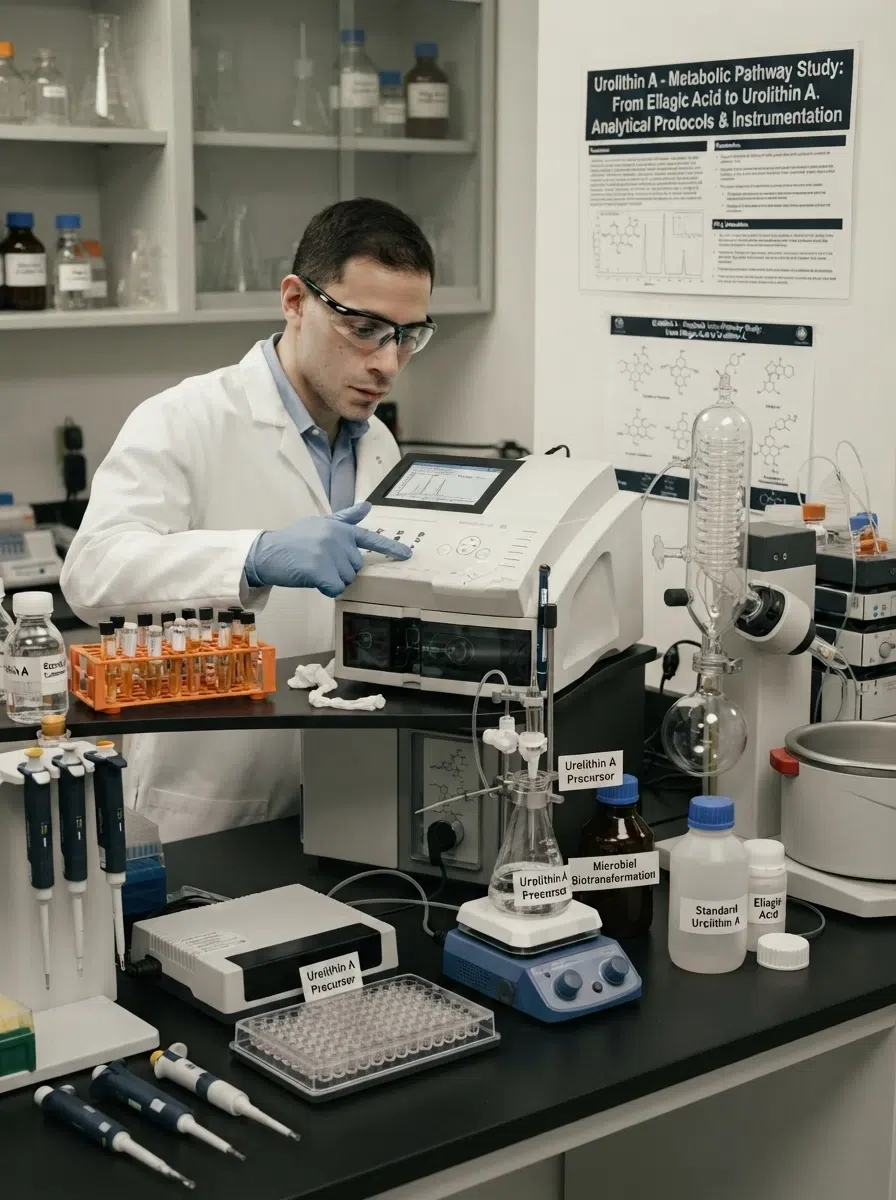
What Urolithin A stability testing is intended to establish
In practice, a stability program examines whether a material remains within agreed quality criteria over time under stated conditions. For a bulk powder, the relevant attributes may include identity, assay, related substances, moisture, appearance, particle properties, density, flow or microbiological quality. The selected panel should reflect the material route, package and intended use.
For example, stability data can support a retest period, a storage instruction, a transport decision or a change assessment. However, it does not automatically establish the performance of a finished capsule, beverage or other formula. Each finished product has its own matrix, package and process.
Stability decision map
| Decision | Stability evidence that may contribute | Additional evidence |
|---|---|---|
| Raw-material retest period | Lot-specific data under stated storage and package | Approved specification and retest procedure |
| Storage instruction | Change trends under temperature, humidity, light or package conditions | Warehouse and shipping controls |
| Transport assessment | Excursion or shipment simulation data | Route, duration and container information |
| Packaging change | Comparison of old and new configurations | Container qualification and implementation record |
| Finished-product shelf life | Matrix-specific stability results | Finished formula, process and package study |
Use the Urolithina Lab quality framework to organize the document request, then define the exact scope in the buyer’s protocol.
Separate retest period, expiry date and shelf life
First, a raw-material retest period identifies when the material should be re-examined against its specification. By contrast, an expiry date is a defined end point assigned under a particular system. Finished-product shelf life describes the period during which a completed product is expected to meet its own criteria in its own package.
Therefore, these terms should not be exchanged casually. For example, a supplier may have sufficient data for a retest statement on a sealed bulk pack but not for the shelf life of a finished formulation. The label, COA and quality agreement should use the term that matches the evidence.
Terminology check
| Term | Scope | Question to ask |
|---|---|---|
| Retest period | Raw material is examined again before use or release | Which tests and package apply at retest? |
| Expiry date | Defined end date under a controlled assignment system | What data and rule support the date? |
| Shelf life | Finished product remains within its approved criteria | Was the finished matrix and package studied? |
| In-use period | Material or product after opening or preparation | Were repeated openings and handling studied? |
| Storage instruction | Condition intended to maintain the stated quality | What excursion or monitoring controls are assumed? |
In practice, clear terminology protects both sides of a supply relationship. It stops a buyer from applying a bulk-material statement to a finished formula without supporting data.
Define the stability question before choosing conditions
First, start the protocol with a decision statement. For example, protocol goals can include “support a 24-month retest period in the sealed commercial package” or “compare the proposed liner with the current liner under the existing storage instruction.” The statement should identify material, package, condition and endpoint.
However, do not begin with a generic temperature and time table. Conditions should challenge the risks that matter to the material and the supply route, while remaining interpretable for the intended decision.
Protocol purpose fields
- Material name, grade, physical form and specification version.
- Lot numbers, manufacturing scale and representative-batch rationale.
- Container, liner, closure, fill quantity and label configuration.
- Storage conditions, light status, humidity and monitoring method.
- Time points, test panel, method versions and acceptance criteria.
- Decision to be supported and responsible approval group.
- Handling of deviations, excursions, failed tests and additional samples.
As a result, a protocol that defines the decision first is easier to audit than a collection of tests assembled after the results are known.
Select representative lots for a meaningful study
First, a stability lot should represent the material and process for which the conclusion will be used. Then, consider manufacturing scale, process route, packaging line, raw-material source and the range of normal quality results. A single exceptional lot may not support a broad supply statement.
For an early program, one lot can generate useful information about a package or condition. By contrast, a formal retest period may need more than one lot or a justified bracketing and matrixing design. The protocol should explain why the selected lots are sufficient.
Lot-selection questions
- Does each lot use the process and package covered by the decision?
- Are the lots from representative production scale?
- Do the starting materials and manufacturing site match the intended supply?
- Are initial results near the middle of the normal range or unusually favorable?
- Were any lots reprocessed, repacked or subject to an unusual deviation?
- Is the sample quantity sufficient for all planned time points and repeats?
Finally, record the selection rationale in the study file. Without it, later users may assume the data cover a wider population than they actually do.
Choose long-term and accelerated Urolithin A stability testing conditions
First, long-term conditions should represent the intended storage environment. By contrast, accelerated conditions can reveal a potential change sooner, but they do not automatically predict every long-term outcome. Stress conditions are useful for understanding pathways of change, provided the results are not presented as routine storage data.
In addition, temperature, humidity, light and oxygen exposure should match the material’s known sensitivities and package. Monitor the actual chamber conditions, not only the set point. If excursions occur, they need a documented impact assessment.
Condition-selection table
| Condition type | Purpose | Interpretation limit |
|---|---|---|
| Long-term | Represents intended storage over the proposed period | Most directly supports the stated storage scope |
| Accelerated | Provides earlier information about change rate | Does not replace long-term data for every decision |
| Stress | Explores likely degradation or physical-change pathways | Conditions may exceed normal warehouse exposure |
| Transport simulation | Examines route, vibration and short-term excursion | Applies to the tested route and package configuration |
| In-use | Examines repeated opening, sampling or preparation | Does not describe a sealed container |
The ICH quality-guideline library provides a recognized reference point for stability-study thinking. Apply the current guideline version and the requirements relevant to the buyer’s market and product category.
Match the package to the stability claim
Packaging is part of the study, not a footnote. A foil-lined bag, high-barrier pouch, drum liner and small laboratory bottle can expose the same powder to different moisture, light, oxygen and headspace conditions. In addition, the pack size and opening pattern can also change the in-use environment.
First, record the container material, liner, closure, seal, fill quantity, headspace, orientation and storage position. If the commercial pack differs from the study pack, document the technical bridge rather than assuming equivalence.
Package fields to retain
| Field | Review question | Evidence |
|---|---|---|
| Primary container | Does the material and barrier match commercial supply? | Packaging specification and supplier declaration |
| Liner and closure | How is the seal formed and checked? | Closure description and inspection record |
| Fill quantity | Does headspace differ from the study? | Pack configuration and calculation |
| Opening pattern | Is the container opened once or repeatedly? | In-use instruction and handling plan |
| Label and lot | Can every stability unit be traced? | Unit label, sample map and chain of custody |
Therefore, a stability statement should name the package or package family it covers. “Store in a cool, dry place” is not a substitute for a defined container and condition.
Design time points and sample quantities
For Urolithin A stability testing, time points should show the initial condition, the expected storage interval and the period around the proposed decision. Include enough units for planned tests, repeats, investigations and retained reserve. Remove a unit from the chamber only when the protocol calls for that time point.
However, do not repeatedly open one stability container for every time point unless the study is specifically designed as an in-use study. Repeated opening changes the exposure and can confuse a sealed-pack conclusion.
Time-point planning
- Define the initial time point before storage begins.
- Include early, middle and end points appropriate to the proposed period.
- Add an accelerated or stress time point only with a defined purpose.
- Reserve units for repeat testing and confirmed investigations.
- Record chamber entry, withdrawal time and sample condition.
- Document any missed, late or substituted time point.
For a supplier study, ask for the sample map and remaining reserve inventory. As a result, this makes it possible to interpret a later result without guessing which unit was opened or retested.
Choose a stability-indicating test panel
First, the test panel should detect changes that matter to the material’s specification and use. For example, chemical attributes may include identity, assay and related substances. Physical attributes may include colour, agglomeration, moisture, particle-size distribution, density or flow. Microbiological tests may apply when the material, process and specification require them.
However, not every test belongs at every time point. The protocol should explain the frequency and reason. For example, a visual observation may be useful at each withdrawal, while a detailed particle or microbiology test may be scheduled at selected points.
Panel-selection matrix
| Attribute | What it can show | Review note |
|---|---|---|
| Identity | Whether the defined material identity remains supported | Use a controlled method and compare meaningful profile changes |
| Assay | Change in target-content result under the method | Record basis, standard and method version |
| Related substances | New or increasing chromatographic components | Use a suitable reporting threshold and integration rule |
| Moisture | Moisture uptake or loss under the package and condition | Link to sample conditioning and package history |
| Physical properties | Aggregation, particle shift, density or flow change | Use methods that match the intended handling decision |
| Microbiology | Change in the agreed microbiological quality fields | Apply the product specification and sampling plan |
Use the current Urolithin A specification page to identify candidate attributes, then confirm the final panel with QA and the intended application owner.
Confirm that methods can detect meaningful change
For Urolithin A stability testing, a method should be capable of distinguishing the target from relevant change products, matrix components and preparation artefacts. A method that only reports a headline assay may miss a shift in related substances, moisture or physical form.
First, review method version, sample preparation, reference standard, system suitability, reporting threshold and solution hold time. If a method changes during the study, compare the old and new procedures before combining the trend.
Method-suitability questions
- Can the method distinguish the target from relevant new peaks?
- Is the calibration range suitable for every stability time point?
- Are sample and standard solutions stable for the run duration?
- Are integration and reporting rules consistent across time points?
- Does the physical test use the same conditioning and package history?
When a change is close to a limit, retain the chromatograms, calculations, raw observations and sample photographs needed to reconstruct the decision.
Control chamber monitoring and excursion assessment
For Urolithin A stability testing, chambers should have defined operating ranges, monitoring records, calibration status and alarm handling. However, a chamber set point is not proof that every unit experienced the same condition. Review actual records for the period that the samples were stored.
First, an excursion assessment should identify duration, magnitude, affected units, attribute sensitivity and available data. Do not discard a study automatically because of a short excursion, and do not ignore a long excursion because the final assay still passes.
Excursion record
| Field | Record | Decision use |
|---|---|---|
| Chamber | Unit, location and calibration status | Confirms the study environment |
| Event | Start, end, magnitude and alarm response | Defines exposure outside the protocol |
| Affected units | Lot, shelf position and time point | Scopes the technical assessment |
| Attribute sensitivity | Moisture, assay, impurity or physical concern | Prioritises supporting tests |
| Disposition | Continue, add testing, qualify or invalidate | Creates an authorised outcome |
Finally, keep the excursion assessment with the stability record. A note in a maintenance log is not enough to explain why a data point remains valid.
Manage sample handling, withdrawals and reserves
In practice, stability samples need a chain of custody from chamber to laboratory. Record the withdrawal time, condition, container status, transport, preparation and test start. For moisture-sensitive powders, the time between opening and analysis may materially affect the result.
In addition, reserve samples should be protected under the defined condition and used only under an authorised plan. If a reserve replaces a damaged or missing unit, document the reason and the impact on interpretation.
Sample-chain checklist
- Match the unit label to the stability map and lot record.
- Record container condition, seal and visible change at withdrawal.
- Use a defined transport and conditioning instruction.
- Log preparation, analysis start and any hold time.
- Retain unused material, chromatograms, calculations and images as required.
- Document substitutions, repeats or damaged units before testing.
As a result, good sample control prevents a later disagreement from becoming a debate about which material was actually tested.
Interpret trends, out-of-trend results and limits
For example, a result can remain within specification while trending toward a limit. Conversely, one unusual result may reflect measurement or sample variation rather than a material shift. Review the full sequence, replicate data, method performance and historical lots.
First, define out-of-trend criteria before the study begins when possible. For example, the rule may use a statistical trend, a predefined change from baseline, a method repeatability limit or a technical review threshold. The decision should not be invented after seeing an inconvenient result.
Trend-review questions
- Is the change monotonic, variable or isolated?
- Does it appear in related attributes such as moisture and density?
- Is the shift larger than method repeatability?
- Does the trend depend on one lot or package?
- Was there a chamber excursion, method revision or sample-handling event?
- Does the result change the proposed retest or storage decision?
In addition, use graphs with the numerical table and method version. A smooth chart without the underlying values can hide rounding, missing time points or a changed calculation basis.
Use accelerated Urolithin A stability testing data with defined boundaries
In practice, accelerated conditions can help identify likely change pathways and support an early technical decision. However, they do not create a simple conversion factor for every material, package or attribute. Some changes are nonlinear, moisture-driven or reversible; others appear only under normal storage.
Therefore, state which conclusions accelerated data can support and which require long-term confirmation. If the study uses a model or extrapolation, record the assumptions, data range and approval authority.
Accelerated-data review
| Review item | Question | Why it matters |
|---|---|---|
| Condition severity | Does it represent a defined stress or an expected excursion? | Prevents overextending the conclusion |
| Attribute response | Which properties changed first? | Identifies the likely limiting attribute |
| Package | Was the commercial container tested? | Barrier and headspace affect interpretation |
| Model | Is any extrapolation justified and documented? | Assumptions can dominate the conclusion |
| Confirmation | What long-term data remain open? | Defines the scope of the provisional decision |
Finally, do not present a provisional accelerated conclusion as a completed long-term study. Label the status in the technical file and on any customer-facing document.
Assess transport excursions and warehouse exposure
During Urolithin A stability testing, transport can expose a sealed pack to temperature cycling, humidity variation, vibration, pressure changes and delays. The assessment should use the actual package, route, duration and likely exposure rather than a generic statement about shipping.
For a shipment excursion, identify the affected lots and packaging, reconstruct the temperature or humidity history when possible and compare the exposure with the available stability evidence. Then, test the attribute most sensitive to the event and record the disposition under the buyer’s quality system.
Transport-review fields
- Route, transit duration, carrier and container configuration.
- Temperature and humidity logger data, if available.
- Seal, liner, pallet and outer-case condition.
- Delay, customs hold, warehouse transfer or repacking event.
- Lot-specific test results and comparison with baseline.
- Disposition, customer notification and follow-up action.
The Urolithin A procurement brief can capture route, package and destination information at quotation stage so that later stability questions have the right context.
Link stability conclusions to change control
Because a new package, supplier, manufacturing site, drying condition or analytical method can change the relevance of an existing stability study, open a change assessment before assuming that historical data cover the new condition.
First, the assessment should identify the old and new states, affected lots, attributes, bridging data, updated documents and implementation rule. If additional stability units are needed, define their protocol and status rather than adding informal samples to the old study.
Change-to-stability checklist
- Describe the change and the first affected lot.
- Compare material, process, site, package and method against the study scope.
- Identify attributes that may no longer be represented.
- Decide whether bridging, a new study or a document-only update is appropriate.
- Update the storage statement, COA reference and customer notification if needed.
For a detailed supplier-notification workflow, use the separate quality documentation resources and connect the decision to the active quality agreement.
Define supplier and buyer responsibilities
Typically, the supplier controls manufacturing, packaging, chamber operation and laboratory records. By contrast, the buyer controls its intended use, receiving conditions, internal release and finished-product decisions. A good agreement makes the boundary visible.
First, specify who owns the protocol, who approves changes, who receives interim results, who investigates excursions and who can assign or revise a retest statement. Also define how the supplier communicates a new lot, package or method that falls outside the original study.
Responsibility matrix
| Activity | Supplier role | Buyer role |
|---|---|---|
| Study protocol | Provide material, package and chamber proposal | Confirm intended use and decision scope |
| Testing | Run controlled methods and preserve records | Review methods or conduct agreed confirmation |
| Excursion | Assess chamber or shipment event | Assess receiving and finished-product impact |
| Retest statement | Assign within documented evidence | Accept for the agreed product and market |
| Change | Notify before affected supply | Review, approve or condition receipt |
However, responsibility does not mean that one party can make a conclusion outside the evidence it controls. Keep each statement tied to the material and decision in scope.
Assemble a Urolithin A stability testing evidence package
In practice, a buyer should be able to reconstruct the study without requesting a new explanation for every lot. The file should include the protocol, lot rationale, package description, chamber records, sample map, methods, results, deviations, trend review and signed conclusion.
The technical resources page can be used to organize a request for these files. However, ask for controlled summaries when raw data are proprietary, but ensure the summary still identifies the method, lot, time point and conclusion.
Evidence-package index
| File | Minimum content | Review purpose |
|---|---|---|
| Protocol | Purpose, lots, package, conditions, time points and tests | Defines what the study can support |
| Chamber record | Monitoring, calibration, alarms and excursions | Confirms actual exposure |
| Sample map | Unit, lot, withdrawal and chain of custody | Connects result to physical sample |
| Analytical records | Methods, results, calculations and review | Shows how attributes were measured |
| Trend assessment | Plots, tables, OOT review and conclusion | Explains the decision over time |
| Final report | Scope, limitations, retest or storage statement and approval | Controls how the conclusion is used |
First, file names should include product, lot, package, condition and time point. This simple control reduces the chance that a representative study is attached to the wrong commercial lot.
Build a stability review scorecard
For Urolithin A stability testing, a scorecard helps QA distinguish a complete study from a short storage note. In addition, it shows which missing document would most improve the decision.
Stability evidence scorecard
| Area | Strong evidence | Conditional evidence | Gap |
|---|---|---|---|
| Scope | Material, package, condition and decision are explicit | Storage condition is clear but package scope is pending | Generic shelf-life statement |
| Lots | Representative lots with documented rationale | One lot with limited scope | Unidentified or unusual sample |
| Conditions | Actual chamber records and excursion review | Set points available with monitoring summary | No exposure record |
| Panel | Chemical and physical attributes match the risk | Core assay data with selected supporting tests | Assay only with no rationale |
| Trend | Numerical data, plots and OOT assessment | Pass/fail table with limited trend context | Single end-point result |
| Conclusion | Defined retest, storage scope and approval | Provisional conclusion with open actions | Unbounded claim |
Finally, use the scorecard to prioritize follow-up. It does not replace a validated study protocol, laboratory review, quality agreement or finished-product stability program.
Frequently asked questions about Urolithin A stability testing
Can one stability lot support every Urolithin A package size?
Not automatically. For example, headspace, liner, fill depth and opening pattern can change exposure. A technical bridge may be possible, but the package relationship and assumptions need to be documented.
Is an accelerated study enough to assign a retest period?
It may support an early technical assessment, but it does not automatically replace long-term data. The conclusion should state which conditions were tested, what was extrapolated and what confirmation remains open.
Which tests belong in a raw-material stability panel?
In practice, the panel depends on the specification, process and package. For example, identity, assay, related substances, moisture, appearance and relevant physical or microbiological attributes are common candidates, but each should have a decision rationale.
What should happen after a chamber excursion?
First, record the duration and magnitude, identify affected units, review attribute sensitivity and conduct the approved impact assessment. Continue, add testing, qualify or invalidate the affected data using an authorised decision.
Does a passing assay prove that the powder is stable?
No. However, assay may remain within limits while moisture, related substances, particle properties or appearance change. Review the complete panel and the material’s intended use.
Can a supplier’s raw-material retest period be copied to a finished product?
No. Because a finished product has a different matrix, process, package and storage exposure, it requires its own stability evidence and release criteria.
How should a buyer handle an out-of-trend result?
First, preserve the original sample and records, check method and chamber history, compare related attributes and follow the approved investigation procedure. Do not replace the result with a convenient retest without a documented rationale.
Turn Urolithin A stability testing data into a controlled storage decision
A defensible Urolithin A stability testing program links a representative lot to the commercial package, actual storage exposure, suitable methods, planned time points and an explicit decision rule. Therefore, the value lies in the traceable chain, not in a long storage claim printed without scope.
Before approving a retest period or storage instruction, request the protocol, package description, chamber records, sample map, complete test panel, trend review and signed conclusion. For a lot-specific review, use the quality-file request form and include the destination market, package configuration and intended product stage.
Scope note: This article is a B2B ingredient-quality framework. It does not replace the buyer’s validated methods, formal stability protocol, quality agreement, regulatory assessment or finished-product release system.