A Urolithin A supplier audit starts with more than a polished document package: a supplier can provide complete-looking documents and still leave important quality-system questions unanswered.
Urolithin A supplier audit work gives buyers a structured way to examine how a supplier makes, tests, releases, stores and documents the material. The objective is not to collect a certificate or score a presentation. It is to verify that the supplier’s processes can consistently produce the quoted material and that the records support a controlled commercial decision.
This checklist is for procurement leaders, QA auditors, analytical scientists, contract manufacturers and importers. It covers audit planning, site scope, personnel, materials, production, laboratories, data integrity, traceability, change control, complaints, CAPA, remote evidence and follow-up. The final audit protocol should match the buyer’s quality agreement, market and material risk.
Working rule: audit the process that creates the evidence, not only the documents that summarize it.
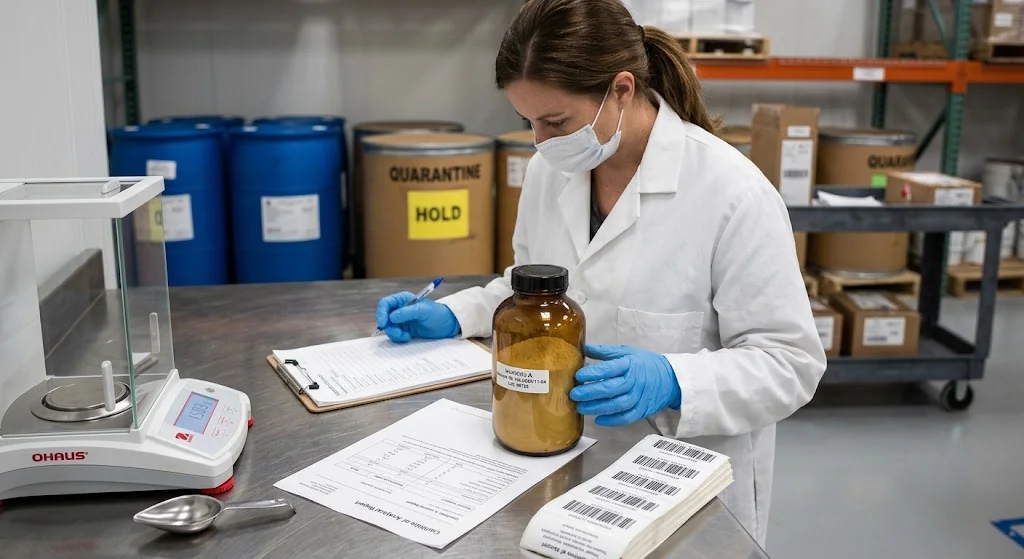
What a Urolithin A supplier audit should establish
An audit should answer whether the supplier’s quality system is suitable for the material and the buyer’s intended use. It should verify the relationship among the legal entity, manufacturing or packing site, laboratory, release authority and commercial documents.
The audit is not a substitute for lot testing or a quality agreement. It provides system-level evidence that helps the buyer decide how much verification, sampling and ongoing oversight the supplier requires.
Audit decision map
| Audit question | Evidence to review | Decision supported |
|---|---|---|
| Who controls the supply? | Legal entity, site roles, contracts and release authority | Supplier and site qualification |
| How is the material made? | Process map, equipment, records and in-process controls | Process understanding and risk review |
| How are results generated? | Methods, standards, instruments, raw data and review | Laboratory confidence and verification plan |
| How are changes managed? | Change records, notifications, comparisons and approvals | Ongoing supply control |
| How are problems closed? | Deviations, complaints, investigations and CAPA | Quality-system maturity and follow-up |
Use the Urolithina Lab quality framework to organize the evidence request before the audit begins.
Set the Urolithin A supplier audit scope and risk before scheduling
The scope should identify the product, grade, site, process steps and intended decision. A distributor audit, a manufacturer audit and a subcontract laboratory audit require different questions. A site that only packs a powder should not be audited as if it performs the synthesis or purification.
Set a risk level using the material’s application, supply volume, process complexity, history, market and consequences of a quality failure. The risk level can determine whether the audit is on-site, remote, document-based or combined with lot testing.
Pre-audit scope fields
- Legal entity, manufacturing site, packing site and laboratory locations.
- Urolithin A grade, product code, batch size and package.
- Process steps included and outsourced operations.
- Destination market, product stage and customer requirements.
- Known changes, complaints, deviations or previous audit findings.
- Audit type, dates, participants, language and evidence access.
- Decision required: qualification, renewal, escalation or corrective follow-up.
A written scope keeps the audit focused. It also prevents a supplier from preparing a general corporate presentation that does not address the material or site under review.
Urolithin A supplier audit: verify legal entity, site role and supply-chain ownership
Start by mapping who sells the material, who makes it, who packs it, who tests it and who releases it. Different names on the quotation, COA, label, invoice and export record need a documented relationship.
Ask whether the supplier uses brokers, contract manufacturers, subcontract laboratories, third-party warehouses or external logistics providers. Each handoff can change traceability and document ownership.
Entity and site questions
| Area | Audit question | Evidence |
|---|---|---|
| Legal entity | Which company signs the order and quality agreement? | Registration, contract and authorised contact |
| Manufacturing role | Which site performs each operation? | Process map and site profile |
| Laboratory role | Who performs release testing and who reviews it? | Lab scope and release procedure |
| Warehouse role | Where is material stored before shipment? | Warehouse address and handling records |
| Subcontracting | Which activities are outsourced and approved? | Contracts, qualification and oversight records |
The Urolithin A procurement brief can capture the entity and site map before the audit request is sent.
Review the quality organization and personnel
A quality system depends on people with defined authority, training and time to perform their responsibilities. Review the organization chart, quality independence, deputies, training records and turnover in critical roles.
Ask the quality lead to explain how a batch is released, how a deviation is escalated and how a customer complaint reaches the investigation team. Practical explanations often reveal whether the written procedure is used in daily work.
Personnel evidence
- Current organization chart and quality reporting line.
- Role descriptions for production, laboratory, warehouse and release staff.
- Training matrix for methods, sampling, data review and document control.
- Qualification and requalification records for analysts and samplers.
- Deputy and escalation arrangements for absences or urgent events.
- Recent turnover, vacancies and temporary staffing in critical roles.
A supplier does not need to disclose personal information outside the audit scope. The buyer does need enough evidence to understand who can perform and approve quality decisions.
Walk through material control and traceability
Traceability should run from incoming materials to the finished Urolithin A lot and then to the shipped package. Select one recent lot and follow it through receiving, weighing, processing, testing, packing, release and dispatch.
Look for consistent lot numbers, status labels, material balances, electronic records and reconciliation of rework or waste. A procedure may appear complete while the selected batch record reveals gaps between steps.
Traceability walkthrough
- Select a recent commercial lot and record its identifiers.
- Trace starting materials and their supplier lots.
- Follow the batch record through each process and hold step.
- Match in-process samples and laboratory results to the lot.
- Verify package labels, quantity, release record and shipment file.
- Check whether any repacking, blending or relabelling is visible in the history.
Traceability evidence is stronger when the auditor can see the original record rather than only a transcribed summary.
Review incoming-material and supplier qualification controls
The supplier’s own inputs can influence identity, impurity profile, physical properties and consistency. Review how starting materials, catalysts, solvents, water, packaging and contract services are approved and monitored.
Ask how a new source is qualified, how specifications are set, how incoming results are reviewed and how changes are communicated to production and quality. The control should distinguish approved suppliers from temporary or emergency sources.
Input-control checklist
| Control | Audit question | Evidence |
|---|---|---|
| Supplier approval | Who approves and periodically reviews an input supplier? | Qualification record and review schedule |
| Specification | Are identity, quality and contamination fields defined? | Current input specification |
| Receipt | Are lots sampled and status-controlled before use? | Receiving and testing records |
| Change | Are source or grade changes assessed before use? | Change notification and impact review |
| Service provider | Are external laboratories and warehouses qualified? | Contracts, audits and performance review |
Connect input controls to the supplier’s process risk. A generic approved-vendor list is not enough if it does not identify the material and operation in scope.
Review manufacturing controls and batch records
Read the process map with the operator and compare it with a completed batch record. Review critical parameters, equipment identification, line clearance, additions, holds, deviations, yields and in-process checks.
Ask what happens when a parameter is outside its range. The response should be defined in a procedure, not improvised during the audit. Check whether operators record actual values or only initial and final signatures.
Batch-record review points
- Approved master record and current revision.
- Equipment ID, cleaning status and line-clearance check.
- Material lots, weights, additions and verification signatures.
- Critical process parameters and actual recorded values.
- In-process sample identity, results and response to failures.
- Yield, reconciliation, rework, hold time and final disposition.
- Corrections, electronic audit trail and reviewer approval.
One completed batch record is often more informative than a general description of the manufacturing process because it shows how the system operates under real conditions.
Examine equipment, utilities and maintenance
Equipment should be suitable for the process, identified, maintained and cleaned under controlled procedures. Review the condition and history of reactors, filters, dryers, mills, mixers, packaging lines and storage areas relevant to the Urolithin A lot.
Utilities such as water, compressed gases, ventilation and environmental controls can influence quality. The audit should focus on systems that contact the material or affect the process environment.
Equipment and utility evidence
| System | Audit question | Evidence |
|---|---|---|
| Equipment | Is the equipment identified and within maintenance status? | Asset list and maintenance record |
| Calibration | Are instruments calibrated for the measurements used? | Calibration certificates and out-of-tolerance review |
| Cleaning | Are cleaning instructions and inspection criteria defined? | Cleaning record and verification |
| Water | Is water quality monitored at relevant points? | Specification, results and trend |
| Environment | Are temperature, humidity, dust and access controlled? | Monitoring, alarms and excursion review |
Look for links between maintenance or calibration failures and affected lots. A certificate alone does not show whether an out-of-tolerance event was assessed.
Laboratory review in a Urolithin A supplier audit
The laboratory audit should follow a result from the COA back to the sample, method, standard, instrument and raw data. Review identity, assay, related substances, contaminants and physical tests that support release.
Ask analysts to demonstrate sample preparation, standard handling, system-suitability review and result approval using a representative method. Observe whether the written procedure matches actual practice.
Laboratory audit checklist
- Controlled methods, revisions and authorised copies.
- Reference standards, assigned values, storage and requalification.
- Sample receipt, labels, storage, preparation and disposal.
- Instrument qualification, calibration, maintenance and access.
- System suitability, blanks, spikes, recovery and replicate rules.
- Raw-data review, integration, calculations and result approval.
- Out-of-specification, out-of-trend and invalid-test procedures.
The technical resources page can help organize method and laboratory evidence requests before the audit.
Check data integrity and electronic records
Data integrity means that records are attributable, legible, contemporaneous, original or true copies, accurate, complete, consistent, enduring and available. Review how electronic systems control user access, audit trails, changes, backups, time settings and result approval.
Do not limit the review to whether a PDF looks signed. Ask how raw chromatograms, instrument files, sample sequences, calculations and revised reports are protected and linked to the final result.
Data-integrity questions
| Area | Question | Evidence |
|---|---|---|
| User access | Are accounts individual and permissions role-based? | User list and access review |
| Audit trail | Can changes, deletions and reprocessing be seen? | System audit-trail example |
| Raw data | Are original files retained with the report? | Sample data package and archive |
| Calculations | Are formulas controlled and independently reviewed? | Worksheet or software validation record |
| Backup | Can records be restored and remain readable? | Backup, restore and retention evidence |
For U.S. dietary-supplement quality records, 21 CFR 111.75 describes conditions for relying on certain supplier results within that specific framework. It does not eliminate the buyer’s responsibility to assess method reliability and data control.
Review release authority and COA issuance
Follow one released lot from completed testing to the final COA. Confirm that the release authority reviewed the full panel, resolved deviations and approved the correct specification version before the document was issued.
Check whether COA templates are controlled and whether corrections create a traceable replacement rather than silently overwriting the original. The lot, product code, method, results, units, dates and signatory should remain consistent across the record.
COA-issuance checks
- Confirm the lot and package represented by the certificate.
- Match test names, methods and limits to the current specification.
- Review actual values, units, basis and reporting thresholds.
- Check release signature, date and responsible entity.
- Review corrections, reissued files and document numbering.
- Confirm that representative and commercial-lot certificates are distinguished.
The audit should establish whether a COA is a controlled release record or merely a formatted summary prepared after shipment.
Examine change control and customer notification
Review recent changes to process, site, raw materials, equipment, methods, packaging, labels, subcontractors and specifications. Select a closed change and trace its assessment, evidence, approval, first affected lot and customer notification.
Ask how urgent or temporary changes are handled and when they become permanent. A supplier should be able to show how the change system protects the relationship between approved conditions and shipped lots.
Change-control audit points
- Current and proposed state are described precisely.
- Impact on identity, assay, contaminants, physical properties and records is assessed.
- Comparability, validation, stability or first-lot data are defined.
- Required customer approval or notification is recorded.
- Specifications, methods, labels and COA templates are updated.
- Closure confirms implementation and open actions.
Use the separate quality documentation framework to compare the supplier’s change process with the buyer’s quality agreement.
Review deviations, complaints and CAPA
A mature supplier can show how it investigates failures and turns recurring issues into corrective and preventive action. Select a recent deviation, complaint or laboratory investigation and follow it from discovery to closure.
Check whether the root cause is evidence-based, whether the action addresses the cause and whether effectiveness was verified. A training reminder alone may not address an equipment, method or document-system failure.
CAPA review table
| CAPA element | Audit question | Evidence |
|---|---|---|
| Problem statement | Is the issue defined with lot, process and impact? | Investigation record |
| Root cause | Is the cause supported by data rather than assumption? | Analysis, interviews and records |
| Action | Does the action address the identified cause? | Procedure, equipment or system change |
| Owner and due date | Are responsibilities visible and tracked? | CAPA tracker and approval |
| Effectiveness | Was recurrence checked after implementation? | Follow-up trend or audit evidence |
Repeated late documents, lot mismatches or out-of-trend results should appear in supplier CAPA or performance review, not remain isolated email threads.
Evaluate warehouse, packaging and shipment controls
Audit storage conditions, segregation, status labels, stock rotation, pest control, package inspection, dispatch checks and transport records. The supplier’s process continues until the material leaves under the correct identity and condition.
Review whether repacking, relabelling or consolidation can occur and how those events are recorded. A package change may affect stability, traceability and the scope of the COA.
Warehouse and dispatch checklist
- Quarantine and released stock are physically separated.
- Lot, status, quantity and storage conditions are visible.
- Temperature, humidity and excursion records are reviewed.
- Package integrity and label checks occur before dispatch.
- Repacking, relabelling and returns have controlled records.
- Shipping documents match the released lot and customer order.
For the buyer’s shipment questions, use the procurement brief to define package, route and required records before the audit.
Conduct a remote audit without losing evidence quality
A remote audit can be effective when the supplier provides live, controlled access to records and equipment. Request screen sharing of the relevant system rather than accepting a preselected slide deck. Use a sample lot and ask the supplier to navigate from the lot number to the raw records.
Define how confidential information, screenshots, translations and follow-up files will be handled. A remote format may limit physical observation, so combine it with retained-sample testing, a later site visit or additional document review when the risk warrants.
Remote-audit controls
- Agree the scope, platform, participants and evidence protocol.
- Request live demonstrations of one batch, one result and one change.
- Record document numbers, dates and system screens rather than collecting uncontrolled files.
- Mark evidence that could not be observed remotely.
- Issue findings with owners, due dates and required supporting records.
- Schedule a verification step for high-priority gaps.
Remote does not mean informal. The same decision trail should exist after the meeting as after an on-site audit.
Classify findings after the Urolithin A supplier audit
Findings should describe the requirement, observed evidence, risk and expected correction. Avoid vague language such as “improve documentation.” State the missing control and the record that would demonstrate closure.
Use the buyer’s established grading system. If no system exists, separate critical gaps that could affect identity or reliable release from major system weaknesses and minor documentation issues.
Finding classification
| Finding level | Example | Typical response |
|---|---|---|
| Critical | Traceability or data control cannot support released lots | Escalation, containment and qualification decision |
| Major | System weakness could affect quality or repeated records | CAPA, evidence review and deadline |
| Minor | Limited documentation or housekeeping gap | Correction and routine follow-up |
| Observation | Improvement opportunity without a current failure | Track in supplier-development plan |
Qualification can be approved, approved with conditions, deferred or rejected. Link the decision to the audit scope, open findings, verification plan and monitoring frequency.
Verify corrective actions and close the audit
Closing an audit means confirming that the supplier implemented the agreed action and that the action addresses the finding. A revised SOP without training, a new form without completed records or a promise to improve is not full closure.
Request objective evidence such as revised procedures, completed batch records, system screenshots, training records, method comparisons, first-lot results or effectiveness trends. Record the reviewer, date and final status.
Audit-closure checklist
- Each finding has an owner, action, due date and evidence requirement.
- Root cause and impact are documented for major findings.
- Revised documents carry controlled revision and approval.
- Training or system changes are completed where required.
- First affected lots or records are reviewed after implementation.
- Effectiveness is checked and the qualification status is updated.
Keep the audit report, supplier response, evidence and closure approval together. The next audit should be able to see the history without recreating the previous review.
Build a supplier-audit evidence package
A complete audit file should show the scope, evidence, findings, supplier response, decision and follow-up. Include the pre-audit questionnaire, agenda, participant list, sampled lots, document numbers, photographs or screenshots permitted by the agreement, and the final report.
Audit-file index
| File | Minimum content | Purpose |
|---|---|---|
| Scope and plan | Product, site, date, team and decision | Defines what was reviewed |
| Evidence log | Record number, owner, date and observation | Supports each finding |
| Findings report | Requirement, evidence, risk and classification | Creates an actionable response |
| Supplier response | Root cause, action, owner and due date | Defines the correction |
| Closure record | Evidence review, effectiveness and final status | Closes qualification loop |
Use the technical resources page to organize recurring audit records while keeping the controlled report in the buyer’s quality system.
Urolithin A supplier audit scorecard for buyers
A scorecard makes supplier comparisons more consistent. It should measure evidence strength, system ownership and follow-up performance rather than the polish of a presentation.
Audit evidence scorecard
| Area | Strong evidence | Conditional evidence | Gap |
|---|---|---|---|
| Scope | Site, product, process and decision are explicit | Scope is clear but subcontractors remain open | Generic corporate audit |
| Traceability | Selected lot is followed from input to dispatch | Summary records available with samples pending | Lot path cannot be reconstructed |
| Laboratory | Methods, standards, raw data and review are visible | Controlled summaries with limited raw-data access | COA only, no result trail |
| Data integrity | Access, audit trail, backup and original records controlled | One system review remains open | Uncontrolled changes or missing raw files |
| CAPA | Root cause, action and effectiveness are demonstrated | Action open with owner and date | Repeated issues without system response |
| Follow-up | Findings closed with objective evidence | Conditional qualification with monitoring | No accountable closure |
Use the scorecard to set audit frequency and verification depth. It does not replace lot testing, a quality agreement, a regulatory review or the buyer’s incoming-control SOP.
Frequently asked questions about Urolithin A supplier audits
Does a supplier audit replace incoming testing?
No. An audit evaluates the supplier’s systems and controls. Incoming testing and document review evaluate the specific lot received under the buyer’s release procedure.
Should the audit cover the manufacturer or the trading company?
Cover every entity that performs a quality-relevant activity. If a trading company sells material made and tested elsewhere, the audit should map the manufacturer, laboratory, warehouse and release responsibilities.
Can a remote audit qualify a supplier?
It can contribute to qualification when the scope, evidence access and follow-up are adequate. Physical observation limits should be recorded, and higher-risk gaps may require an on-site visit or additional verification.
What is the most important laboratory audit question?
Ask whether the laboratory can connect the reported result to the sample, method, standard, instrument, raw data and reviewer. That chain is more informative than a certificate template alone.
How should audit findings be graded?
Use the buyer’s system and describe the effect on identity, quality, data reliability and release. Separate critical, major, minor and observation levels only when each level has a defined response and escalation path.
What evidence closes a CAPA finding?
Closure needs objective evidence that the action was implemented and addressed the cause. Depending on the finding, this may include revised procedures, training, completed records, system changes, comparison data or an effectiveness trend.
How often should a Urolithin A supplier be audited?
Set the interval by material risk, site complexity, performance history, changes, complaints and open findings. A stable low-risk supplier may need periodic review, while a new or changing site may need closer follow-up.
Turn an audit into an ongoing supplier-control program
A defensible Urolithin A supplier audit connects legal entity, site role, people, process, laboratory, data, release, change control and CAPA. The value is not the score alone; it is the evidence-backed decision about qualification, verification and continued oversight.
Before scheduling an audit, define the product, site, process, market, records and decision required. For a supplier-quality review, use the quality-file request form and include the lot, specification, laboratory scope and change history you want assessed.
Scope note: This article is a B2B supplier-quality framework. It does not replace the buyer’s audit procedure, validated methods, quality agreement, regulatory assessment or finished-product release system.
48 container Meta Boxes